
Akai DR4d
The Akai DR4d sits at the foundation of the range and establishes the philosophy that would define everything that followed. Rather than attempting to overwhelm the user with graphical editing or deep menu structures, the Akai DR4d presents itself as a straightforward four-track recorder with absolute-time referencing and a strong emphasis on speed. Plug something in, arm a track, press Play and Record, and audio is captured with minimal ceremony. Internally, the machine uses linear PCM recording and hard-disk storage to deliver instant access, rapid location and non-linear editing possibilities that tape simply cannot match. The editing model is pragmatic rather than luxurious. There is only a single level of Undo, crossfades are fixed rather than variable, and complex multi-stage editing remains outside its scope. What it does provide is a tightly integrated set of edit modes that allow segments to be copied, moved, inserted, erased or deleted directly on disk, with operations executed quickly enough to encourage experimentation rather than caution.
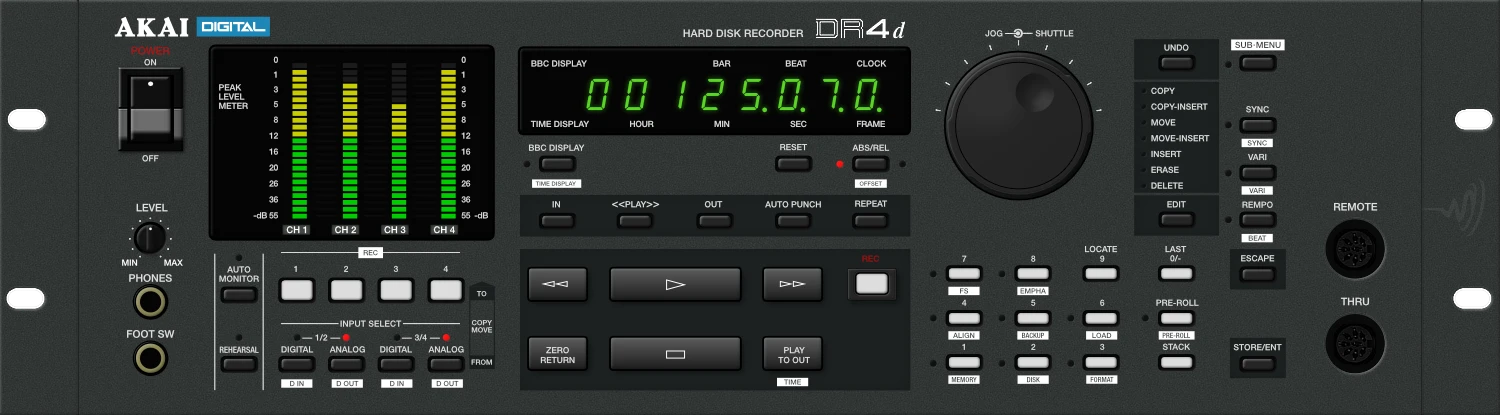
Operationally, the Akai DR4d is anchored by its jog and shuttle wheels, which are central to both navigation and editing precision. In and Out points are programmed in absolute time, and once these concepts are mastered the machine becomes remarkably fast to work on. The optional DL4d remote expands this usability significantly, offering clearer visual feedback and easier access when the main unit is rackmounted. While the Akai DR4d does not exploit every theoretical advantage of hard-disk recording, it succeeds by focusing on the essentials and presenting them in a way that feels dependable, logical and robust. It is very much a recorder-editor designed to replace tape in practical, everyday situations rather than redefine the entire production process.
Akai DR8
The Akai DR8 builds on this foundation by broadening the concept rather than merely scaling it up. Superficially, it is tempting to view the DR8 as a doubled DR4d, but this misses the point. The DR8 introduces eight-track operation alongside a more ambitious internal architecture that brings it closer to a compact production system. In addition to expanded track count, it incorporates a programmable digital mixer capable of handling both disk tracks and external inputs, allowing internal routing, monitoring and submixing without external hardware. This immediately places the Akai DR8 in a different role, particularly for users working on small-scale multitrack projects or post-production tasks where flexibility is as important as raw track count.

The Akai DR8 retains the tape-machine ergonomics that define the range, with dedicated transport controls, individual track arming and fast access to locate points. However, it introduces more sophisticated functions such as Takes, which allow multiple versions of performances or edits to be stored and auditioned easily. This marks a clear move away from tape metaphors and into genuinely disk-oriented workflows, where alternatives can be explored without committing prematurely. Editing remains destructive in nature, but the inclusion of Takes and snapshots mitigates this by encouraging structured experimentation. Synchronisation is another area where the DR8 strengthens the concept, with optional SMPTE, MIDI and machine control cards allowing it to integrate cleanly into larger systems and chase or generate time code with confidence.
Despite these advances, the Akai DR8 remains resolutely hardware-centric. Backup strategies rely on DAT or external storage rather than networked or computer-based solutions, and while this can be slower, it reflects Akai’s emphasis on reliability over novelty. The Akai DR8 proves particularly adept as a central machine in hybrid setups, bridging tape, MIDI systems and digital audio without demanding a wholesale change in working practices.
Akai DR16
The Akai DR16 represents the most complete expression of the Akai hard-disk recorder philosophy. Expanding the concept to sixteen tracks, it aligns closely with the flagship Akai DD1500 while retaining the familiar transport-based operation that defines the DR family. The Akai DR16 is unapologetically professional in intent, offering sixteen tracks of disk recording, a full internal digital mixer, extensive routing and a level of operational depth that clearly targets post-production, broadcast and serious multitrack work. Where the DR8 feels like a powerful evolution of the Akai DR4d, the Akai DR16 feels like a statement that Akai’s hardware-based approach can scale without losing coherence.
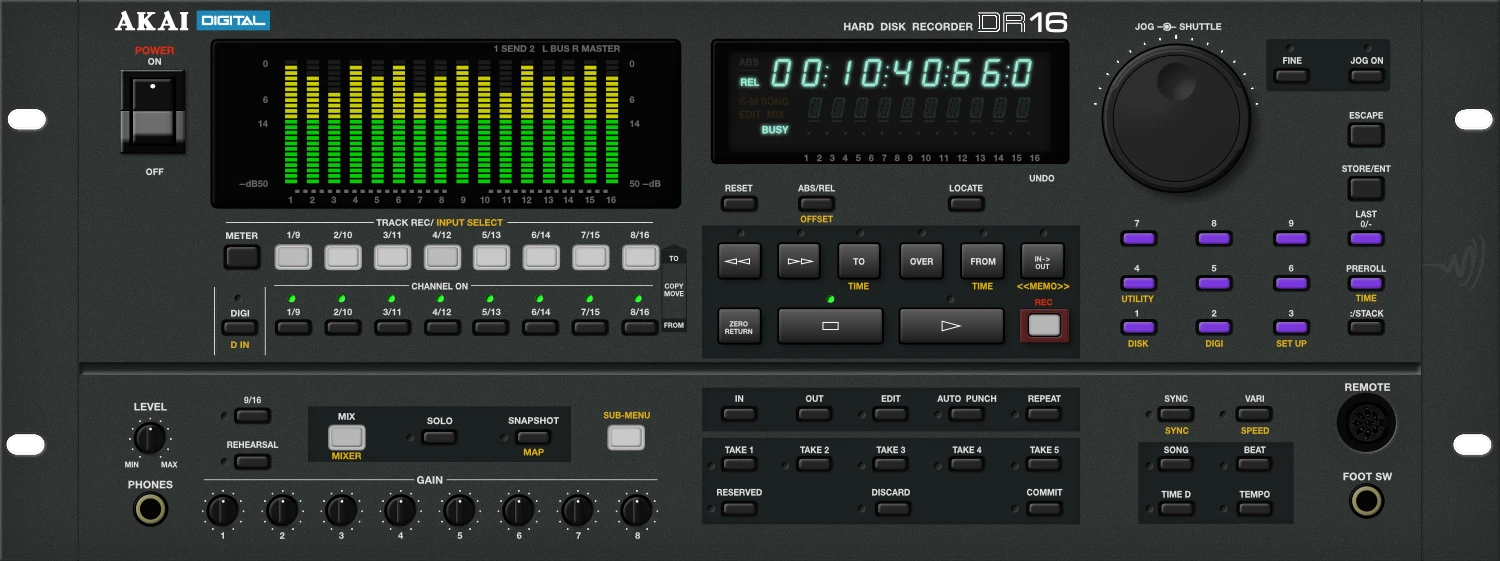
A defining moment for the Akai DR16 is the introduction of SuperView, which addresses one of the persistent criticisms of earlier models: limited visual feedback. SuperView adds external VGA display support and keyboard control, transforming the user experience without abandoning the core design principles. Track activity, waveforms, edit points and project structures become immediately visible, making complex operations faster and more intuitive. Crucially, SuperView does not replace the front-panel workflow but complements it, allowing users to choose between hands-on control and screen-based precision as the task demands. Clipboard editing, enhanced Take management and clearer project organisation elevate the DR16 from a powerful recorder into a genuinely efficient editor, particularly for long-form or multi-project work.
The Range
Across the range, a consistent theme emerges. Akai never attempted to compete directly with emerging computer DAWs on their own terms. Instead, the DR series prioritises determinism, tactile control and operational speed. These machines are designed to be learned thoroughly and then trusted implicitly. Once the logic is understood, operations become second nature, and the machines reward decisiveness rather than endless revision. There are limitations, particularly in terms of Undo depth and backup convenience, but these are trade-offs made in favour of stability and predictability.