Analogue Reverb

Analogue reverb creates ambience through physical means, using springs or metal plates to generate natural reflections with distinctive character. Spring units deliver a bright, slightly metallic sound produced by vibrating coils, while plate reverbs offer smooth, warm decay that became a hallmark of classic studio recordings. Both formats remain valued for their tonal individuality and the vintage depth they add to vocals, instruments and mixes.

Decades
Made In Germany
Released in 1957 /
The EMT 140, introduced in 1957, was the world’s first artificial reverb unit and revolutionised recording by providing “reverb on tap.” Using a suspended metal plate, it delivered rich, natural reverberation, allowing even smaller studios without reverb chambers to create professional-quality ambience. Its warm, versatile sound quickly made it a studio essential.
Made In Germany
Released in 1971 /
In 1971 after huge success with the EMT 140, EMT delivered the EMT 240 Reverb Foil. The surface of the vibrating 0.02 mm gold foil measured only 30 X 30 cm. The foil was contained in a double enclosure affording very high isolation from airborne and solid-borne disturbances, sufficient to allow placement of the EMT 240 even in mobile units or – at a sound pressure level of 105 dB – next to monitor loudspeakers
Made In Austria
Released in 1974 /
The AKG BX-20E is a high-end stereo spring reverb unit using AKG’s Torsional Transmission Line system to deliver natural, dense, and uncoloured reverberation. It features independent decay controls, silent remote adjustment, and full acoustic isolation, with no dry signal in the output. Revered for its smooth, realistic ambience and reliable performance, the BX-20E remains a studio classic.
Made In U.K.
Released in 1976 /
The Klark Teknik DN50 Spring Reverb was introduced around the mid-seventies, just prior to the launch of digital reverbs.
Made In Japan
Released in 1979 /
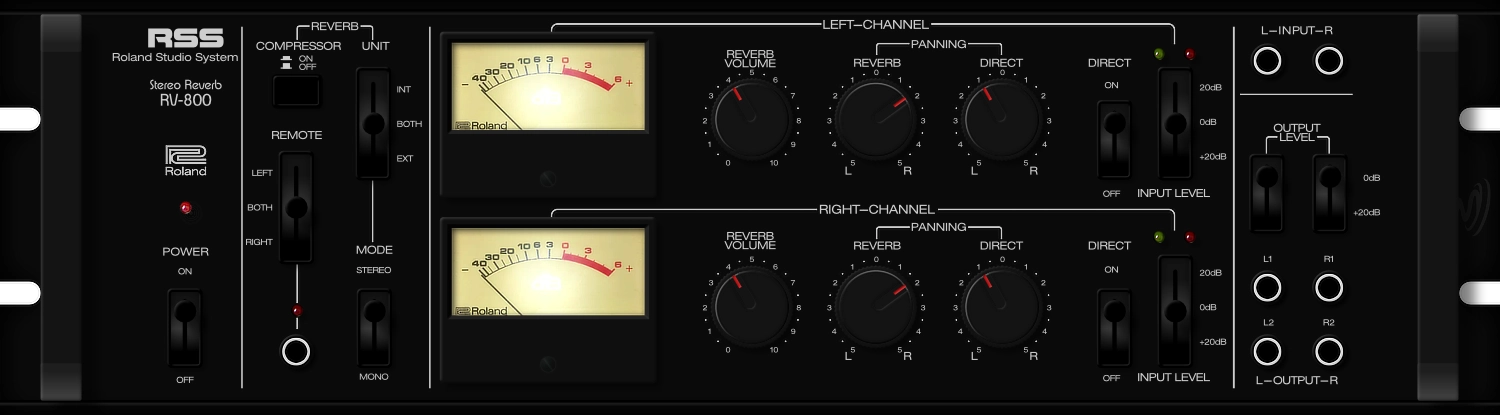
Roland’s 1979 RSS series brought high-quality signal processing to the prosumer market at an affordable price, featuring stereo reverb, phasing, and graphic equalisation. The series integrated seamlessly with Roland’s electronic instruments, ensuring broad compatibility. The standout Roland RSS RV-800 offered stereo reverb with a built-in compressor for minimal distortion, independent panning for versatile soundscapes, and the option to isolate the reverb signal.
Made In Austria
Released in 1979 /
The AKG BX-10E2 is an enhanced version of the BX-10E, featuring a redesigned Torsional Transmission Line (TTL) system and improved equalisation for smoother, more natural reverberation. It uses a series of springs to create accurate reverb without including any dry input signal. This compact, high-performance unit is a reference standard for studio applications and is only outperformed by the larger BX-20E.
Made In U.S.A.
Released in 1979 /
The MicMix XL-305 Master Room Reverb delivers live chamber reverb in a compact, rack-mount design. It eliminates artefacts, handles transients perfectly, and offers stereo capability with built-in EQ, making it ideal for professional studio and live use.
Made In Austria
Released in 1980 /
The AKG BX 5 is a compact stereo spring reverb unit using AKG’s patented Torsional Transmission Line design for smooth, flutter-free reverberation. Offering adjustable input, EQ, and reverb controls, it delivers natural-sounding ambience suitable for both studio and broadcast applications.
Made In U.S.A.
Released in 1981 /
The Orban 111B was a dual-channel spring reverb unit that combined professional-grade electronics with spring delay lines in a single chassis. It featured six springs per channel to ensure low flutter and a bright, natural decay characteristic. The unit included a quasi-parametric midrange equaliser and a bass shelving equaliser for precise tonal control, along with a limiter circuit to manage headroom and reduce artefacts.
Made In U.S.A.
Released in 1982 /
The Furman Sound RV-1 was released around 1982 and is a mono analogue spring reverb system with a limiter built in, an odd combination of effects. The Furman Sound RV-1 is a mono device with TRS or XLR inputs on offer. A stereo model was released sometime later.
Made In Japan
Released in 1985 /
The Korg GR-1 Gated Reverb from 1985 is a compact, rack-mountable unit with high-quality spring reverberators, offering precise control over reverb and decay. With a 3-band equaliser, stereo support, and footswitch control, it’s perfect for studio and live performances, delivering classic ’80s reverb sound.
Made In U.S.A.
Released in 1997 /
The Accutronics AccuVerb is a rare, all-tube stereo spring reverb unit, revered for its rich, vintage sound and versatile controls. Equipped with dual channels, LED VU meters, and adjustable input/output levels, it’s designed for professional audio use. Renowned as one of the best spring reverbs ever made, it remains highly sought-after for its exceptional sound quality.