Audio Recorders

Audio Recording formats, encompassing both stereo and multitrack configurations, are essential tools in the creation and preservation of audio content. Stereo recording formats capture two audio channels, typically left and right, providing a simple yet effective method for reproducing sound with spatial accuracy. Stereo formats are commonly used in music production, broadcasting, and consumer audio devices, offering immersive listening experiences across various media platforms.

Multitrack recording formats, on the other hand, enable the simultaneous recording of multiple audio channels or tracks onto a single medium. This allows for the independent manipulation of each track during the mixing and editing process, offering unparalleled flexibility and creativity in audio production. Multitrack formats are widely used in professional music studios, film and television production, live sound reinforcement, and podcasting, enabling artists and engineers to craft complex arrangements, add effects, and achieve precise control over the final audio product.

Both stereo and multitrack recording formats have evolved over the years, from analog tape-based audio recorders to digital technologies such as hard disc recording, solid-state recording, and computer-based digital audio workstations (DAWs). These advancements have democratized audio production, making high-quality recording accessible to a broader audience while pushing the boundaries of creativity and innovation in the field of sound engineering and music production.

Decades
Made In Japan
Released in 1985 /
The Luxman K-109 is a high-specification three-head stereo cassette deck from the mid-1980s, released in October 1985 under the Alpine/Luxman name. It combined Luxman’s Bridd series styling with a GT transport mechanism, dual capstan tape handling, manual calibration and Dolby B/C noise reduction, making it one of the more advanced cassette decks in the Luxman range of the period.
Made In Japan
Released in 1985 /
The TASCAM 246 is a Four-track, two-speed cassette Portastudio with a full mixer, dbx noise reduction, pitch control, remote and footswitch options, four internal submixes for routing, and memory/zero return for gentle, efficient tape handling.
Made In Japan
Released in 1986 /
Released in 1986, the Akai GX912 Stereo Cassette Deck is a 2U rackmount professional 3-head cassette deck featuring a Super GX head system, closed loop double capstan transport, microcomputer control, and extended 20Hz to 21kHz frequency response on Metal tape.
Made In Japan
Released in 1986 /
Introduced in 1986, the Nakamichi CR-7 is a three-head cassette deck featuring automatic azimuth, level and bias calibration, manual playback-head azimuth adjustment, a direct-drive dual-capstan transport, real-time tape counting and extensive recording controls.
Made In Japan
Released in 1986 /
The Mitsubishi X-86 is a professional fixed-head, two-channel digital audio recorder designed for music recording, broadcast production, post-production, and CD mastering, offering advanced digital processing, error correction, and extensive synchronisation capabilities.
Made In Japan
Released in 1986 /
The Otari DTR-900 (Model II shown here) is a high-end 32-track digital multitrack recorder using the PD format, offering advanced tape handling, precise sync capabilities, and superior audio fidelity for mastering and post-production applications.
Made In Japan
Released in 1987 /
The Sony DTC-1000ES Digital Audio Tape Deck was the world’s first DAT machine, and although it was a consumer machine, it proved to be very successful in the professional world too, perhaps even more so as DAT never really made it in the consumer world.
Made In Japan
Released in 1987 /
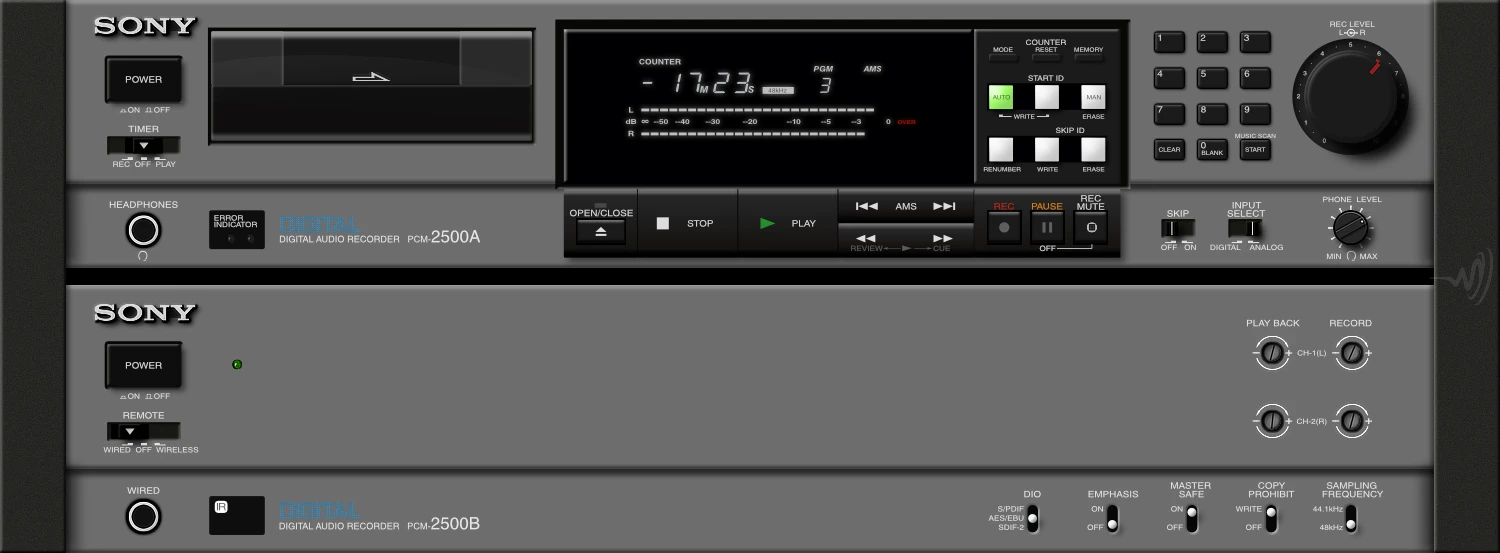
The Sony PCM2500 DAT Recorder took over from the Sony PCM-1630 Series Recorders and kept the DAT format alive for years to come in the studio, (with many successful albums having been mastered to it) but DAT as a format, failed to succeed in the domestic market.
Explore the full Series
Made In Japan
Released in 1987 /
Sony DRD-100 DAT Duplicator is a real-time rack-mount system offering master-quality copying of digital audio and subcode data in up to fifty linked units operating as master or slave with split-use capability.
Made In Japan
Released in 1987 /
The TASCAM ATR-60 Series combines rugged OMEGA transports, microprocessor control and professional I/O in modular two-track, eight-track and sixteen-track machines, with precise shuttling, locator options and pitch control for demanding studio and post-production workflows.
Made In Japan
Released in 1987 /
Introduced around 1987, the JVC TD-V711 is a three-head cassette deck combining a direct-drive closed-loop dual-capstan transport, SA recording and amorphous playback heads, manual calibration, Dolby B, Dolby C and Dolby HX Pro with reinforced three-block internal construction.
Made In Japan
Released in 1987 /
The Akai MG1214 combined a 12 channel mixer, 12 track audio recorder, sync facilities, auto location and computerised patching into one integrated recording system. Released in 1985, it used AKAI’s ½ inch MK20 cassette format and was designed to give musicians a powerful, flexible and self-contained multitrack production system.