
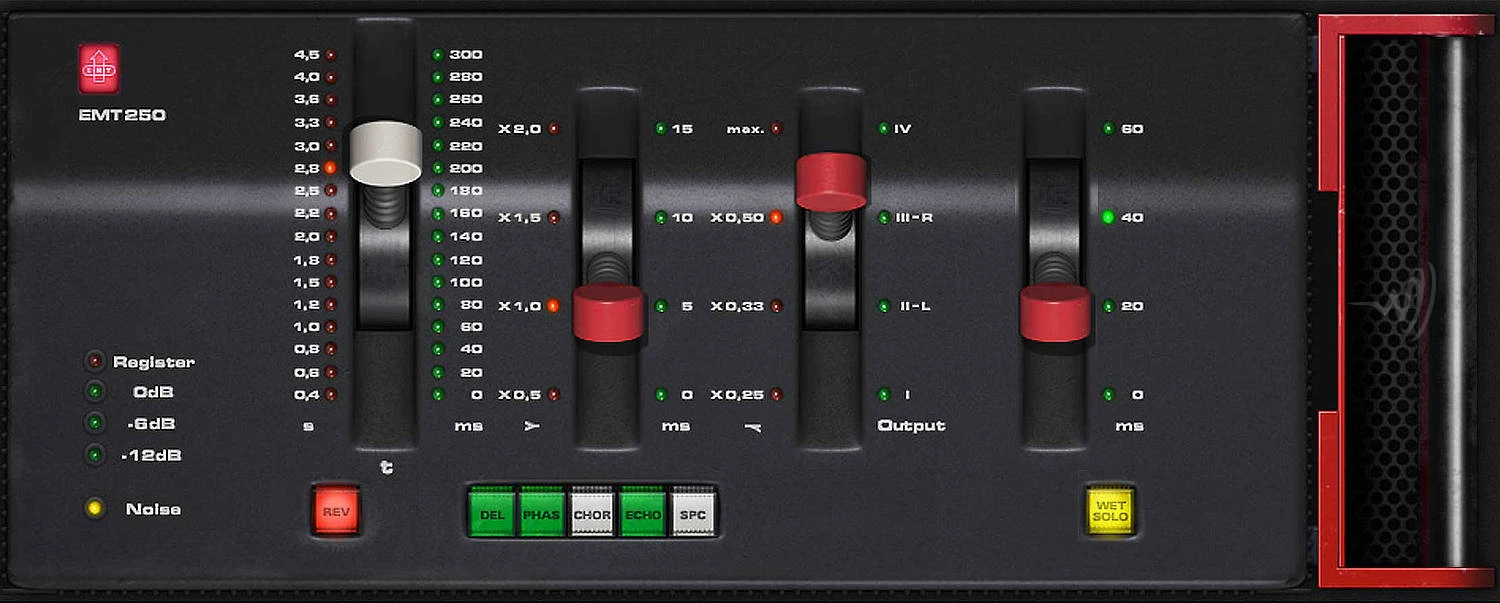
At release, the EMT 250 stood apart from every other reverb system available. Traditional solutions relied on physical movement, whether vibrating metal plates or acoustic spaces. The EMT 250 eliminated all moving parts, instead generating reverb entirely through digital processing. This was not simply an alternative method, but a completely new category of device.
The concept of simulating acoustic environments using computation was groundbreaking. At a time when most studios still depended on large, maintenance-heavy systems, the EMT 250 offered a compact, self-contained solution. From a modern standpoint, this transition laid the groundwork for every digital reverb that followed.
Digital Architecture and Processing Power
The internal design reflects the technological constraints of the era. The unit operates with a 12 bit, quasi 15 bit conversion system and a sampling frequency of 24 kHz. A 20 MHz clock drives the processing, with instruction times measured at 50 ns. While these figures appear modest today, they represented a highly advanced implementation at the time.
The system incorporates memory for delay generation, with up to 60 ms of initial delay in stepped increments, feeding into a complex processing structure. Compared to modern DSP-based systems, the EMT 250’s architecture is relatively simple, yet it was sufficient to produce convincing and musically useful results.
From today’s perspective, the limitations in bandwidth and resolution are evident, particularly with frequency response effectively extending to around 10.8 kHz. However, these constraints contribute to the distinctive character that later became highly valued.
 Control Interface and Operation
The physical design is as distinctive as the technology inside. The EMT 250 is a free-standing unit with lever-style controls mounted on the top panel, reminiscent of aircraft throttles. Each control is clearly associated with LED indicators, providing immediate visual feedback.
Operation is straightforward but flexible. The unit offers multiple modes, including reverberation, delay, echo, chorus, phasing, and space. These are selected via illuminated push buttons, allowing quick changes between effects. In the context of the late 1970s, this level of integration was highly advanced, effectively combining several processors into one unit.
Modern users may find the interface unconventional compared to menu-driven systems, but its immediacy and clarity remain effective.
Reverb Performance and Character
At the time of release, the reverberation quality was considered exceptional. The EMT 250 provided a wide range of decay times, from 0.4 seconds to 4.5 seconds, with additional control over frequency-dependent decay characteristics. The ability to adjust low and high frequency reverberation independently added a level of control not commonly available in mechanical systems.
Listening from a modern perspective, the reverb is recognisably digital yet retains a smooth and cohesive decay. The absence of metallic artefacts common in early digital designs is notable. The sound is dense and controlled, with a clarity that made it suitable for a wide range of applications.
While contemporary reverbs offer far greater complexity and realism, the EMT 250 remains musically effective, with a character that continues to be sought after.
Delay, Echo, and Modulation Effects
Beyond reverb, the EMT 250 includes delay-based effects with impressive flexibility for its time. Delay times extend up to 315 ms, with adjustable increments allowing precise control. The echo mode provides repeat patterns with controlled attenuation, while chorus and phasing effects introduce modulation-based processing.
These additional functions significantly increased the unit’s versatility. In a modern context, these effects are relatively basic, but at the time they represented a powerful extension of studio capabilities within a single device.
Audio Performance and Noise Characteristics
The unit demonstrates strong performance in terms of noise and distortion for its era. Signal to noise ratios vary depending on mode but remain competitive, with figures in the mid 70 dB range. Harmonic distortion is low, and the frequency response is flat up to approximately 10 kHz.
From a modern engineering perspective, these specifications are modest. However, in practical use, the performance was more than adequate, and the unit’s output remained clean and consistent across all four channels.
Build and Engineering Considerations
Construction quality is high, with a robust chassis and well-organised internal layout. The use of high-quality components and socketed boards aids serviceability, although the digital section presents challenges due to its complexity.
The unit’s size and weight, approximately 45 kg, reflect the technology of the time. Compared to modern rack units, it is large and heavy, but it was still significantly more compact than plate reverbs or dedicated echo chambers.
Then vs Now
At release, the EMT 250 was a pioneering product that redefined what was possible in studio processing. It offered unprecedented flexibility, consistency, and ease of use compared to mechanical systems. Its high cost placed it firmly in the professional domain, but its capabilities justified the investment.
Today, digital reverb is ubiquitous, with software and hardware solutions offering far greater processing power and realism. However, the EMT 250 is still regarded as a landmark design. Its sound, shaped by early digital limitations, has become a defining characteristic rather than a drawback.