
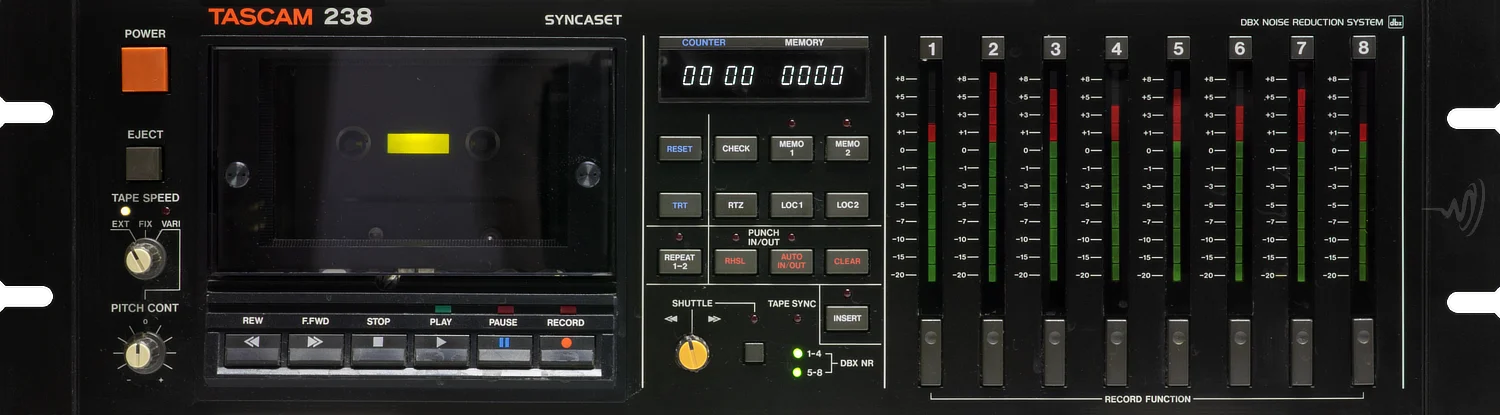
The TASCAM 238 SYNCASET was a cassette-based 8-track recorder that behaved like a true multitrack machine rather than a domestic cassette deck adapted for recording duties. Available since at least 1988, it became popular because it offered a practical, compact, and relatively affordable way to record multiple independent tracks on a standard compact cassette format. That achievement was significant. The compact cassette was never designed as a professional multitrack medium, yet the TASCAM 238 SYNCASET managed to extract a level of performance from the format that made it viable for serious music production where ultimate large-format fidelity was not required.
The most important thing about the TASCAM 238 SYNCASET is the scale of what it attempted. Standard cassette tape is only around 4mm wide, and the 238 SYNCASET had to divide that narrow tape width into eight usable recording tracks while maintaining acceptable noise, crosstalk, distortion, frequency response, and transport stability. It was a technically demanding proposition, and while the format imposed unavoidable limitations, the machine’s measured and audible performance was strong enough to make the 238 SYNCASET much more than a novelty.
Eight Tracks On Cassette
The groundbreaking part of the TASCAM 238 SYNCASET was its ability to place eight tracks onto compact cassette tape and still produce recordings that sounded pretty good. Each track had only around 0.25mm of usable tape width, compared with around 0.7mm on a 1-inch 24-track machine. In theory, this narrow track width carried a significant noise penalty and raised obvious concerns about crosstalk, especially when compared with larger tape formats.
Despite that, the TASCAM 238 SYNCASET delivered a level of performance that made the format credible. It could not remove the physical disadvantages of cassette tape, but it managed them well enough to provide practical 8-track recording in a compact and accessible format. That made the machine particularly valuable for small studios and musicians who needed multitrack flexibility but did not have the space or budget for full-size open-reel equipment.
The result was a recorder that changed expectations for what cassette multitracking could do. The TASCAM 238 SYNCASET did not turn cassette tape into 1-inch or 2-inch tape, but it demonstrated that cassette-based 8-track recording could be useful, reliable, and capable of better results than the format’s dimensions might suggest.
Tape Speed And Format Limits
The TASCAM 238 SYNCASET ran at 9.5cm/sec, which was double the speed of a standard cassette mechanism. This helped improve performance, but it was still only a quarter of the speed used by a large-format multitrack. The slower tape speed meant shorter recorded wavelengths, which placed more pressure on the playback head design and high-frequency recording performance.
As with all analogue tape recording, high frequencies needed to be boosted during recording and reduced again on playback. At lower tape speeds, the point at which this high-frequency boost begins moves downward, increasing the risk of overload or saturation when recording at higher levels. The audible result of overload can be high-frequency loss and unpleasant distortion.
This is where the 238 SYNCASET’s engineering mattered. The cassette format naturally limited dynamic range and high-frequency response at higher recorded levels, but the machine remained capable of excellent performance when used within its limits. At a level just below 0 VU, record-to-replay frequency response was within around ±0.3dB from 70Hz to 15kHz, which was an impressive result for an 8-track cassette recorder.
Noise Reduction And Sound Quality
Noise reduction was central to the TASCAM 238 SYNCASET family’s ability to make cassette-based 8-track recording practical. The original TASCAM 238 SYNCASET used dbx noise reduction, which gave the machine a substantial noise advantage over conventional cassette formats and helped make the narrow-track layout viable for multitrack work. The later TASCAM 238S moved to Dolby S, bringing further improvements in noise behaviour, distortion control, and high-frequency performance, particularly when recording at higher levels.
On the original dbx-equipped TASCAM 238 SYNCASET, the system helped control the background noise that would otherwise have been a major limitation of fitting eight tracks onto cassette tape. The narrow track width inevitably reduced the available noise margin, but dbx allowed the machine to deliver usable multitrack results from a format that was never originally intended for this kind of work.
The Dolby S-equipped TASCAM 238S pushed the concept further. At higher recording levels, replay response without Dolby S began to fall just above 1kHz and reached around -3dB at 13kHz, while Dolby S kept the response within about ±0.3dB. Noise was reduced by around 20dB in the upper frequency region, and weighted noise performance improved by around 22dB compared with operation without noise reduction. The result was a cassette-based 8-track recorder that still carried the unavoidable limitations of narrow tape, but delivered performance that was remarkably strong for the format.
Distortion And High-Level Performance
The TASCAM 238 SYNCASET’s distortion performance was also stronger than might be expected from the format. At moderate levels, third-harmonic distortion was present, and without noise reduction some higher-order distortion products were more apparent. With Dolby S active, the more musically intrusive fifth-harmonic component was removed, and a high-frequency distortion artefact around 16kHz was reduced by about 20dB.
At higher recording levels, tape distortion naturally increased, but Dolby S reduced higher harmonics and made the result more acceptable. In THD+N measurements, distortion was reduced by around 15dB at most frequencies with Dolby S active. Intermodulation distortion was also improved, with the more audible distortion products distant from the original tones virtually eliminated.
This mattered in practical recording because cassette multitrack machines could easily become harsh or congested when pushed too hard. The 238 SYNCASET’s performance showed that, with appropriate noise reduction, it could produce cleaner, brighter, and tighter recordings than machines using earlier noise reduction systems or none at all.
Crosstalk And Track Separation
Crosstalk was an obvious concern for an 8-track cassette recorder. With very narrow tracks and small guardbands between them, the format could reasonably be expected to perform worse than larger machines. Low-frequency fringing was still present, as it is on all tape recorders, where low frequencies spread across the tape during recording and playback.
Above 100Hz, however, the TASCAM 238 SYNCASET’s crosstalk performance improved rapidly. Across the critical midband, crosstalk measured between -70dB and -80dB, reducing to around -60dB at the high-frequency end. This was a creditable result and notably strong for a cassette-based multitrack recorder.
The result was that the 238 SYNCASET could behave like a true multitrack machine, not simply a compromised cassette recorder. It still required sensible track management, but its crosstalk performance supported serious use, including layered recording and additional track work in more complex setups.
Transport Performance And Cassette Limitations
The cassette format brought transport limitations that could not be fully engineered away. In an open-reel machine, the tape path, capstan size, and tape handling can be optimised more freely. In a cassette machine, the capstan size, tape path, and internal cassette shell mechanics impose fixed restrictions.
The TASCAM 238 SYNCASET’s wow and flutter measured around ±0.09% using DIN/IEC peak weighted standards, slightly worse than the stated 0.08% figure. This was not as good as larger open-reel machines, and the difference could be audible on exposed material such as piano, harpsichord, or unaccompanied acoustic guitar. On many types of band or project studio recording, the effect would be less noticeable.
Scrape flutter measured 0.25%, compared with 0.114% on a larger open-reel machine. This type of flutter can be heard as noise modulation on recorded signals, although Dolby S partly reduced the effect. The cassette itself could also have a major influence on this aspect of performance, making tape quality and condition important.
Construction And Operation
The TASCAM 238 SYNCASET was well regarded for its construction and operation. It behaved reliably during the time I used one to transfer TASCAM 8 Track Portastudio tapes from decades earlier, with good tape handling and usefully accurate locator operation. Internally, the machine was well put together, relatively easy to service, and the mechanism had proven durable over time.
Its compact size was part of its appeal. A cassette-based 8-track recorder could never match a carefully designed reel-to-reel machine in absolute performance, but it also did not require the same purchase cost, space, or ongoing tape expense. For compact studios, the 238 SYNCASET offered a practical balance between capability and convenience.
The machine also had potential beyond standalone 8-track work. It could be used to provide an additional seven tracks in a larger recording setup when used as a source of SMPTE time code, or it could work alongside video or a larger SMPTE-slavable multitrack system.