
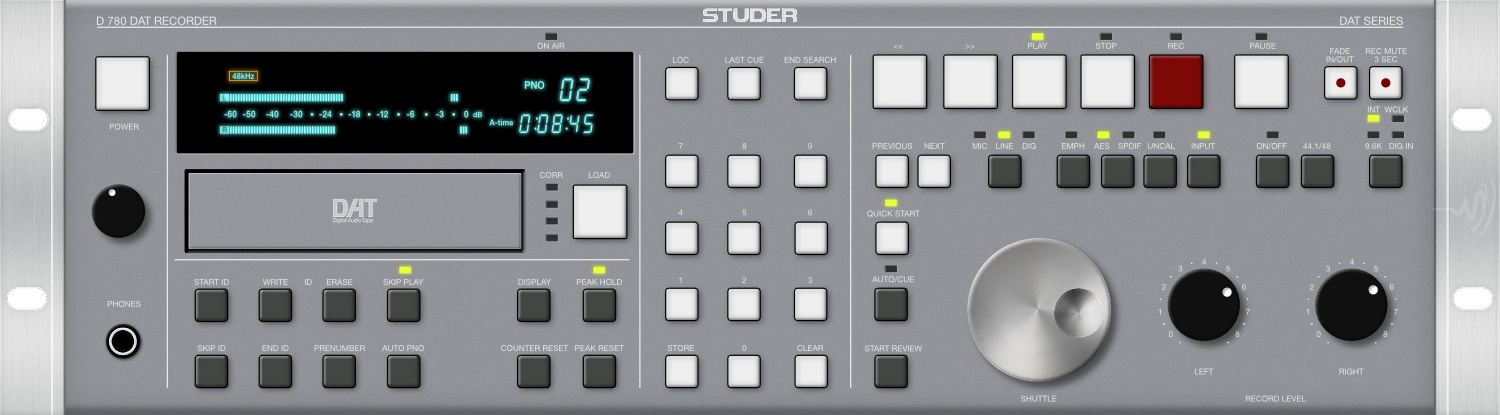
The Studer D780 DAT Recorder marked a significant step forward for R-DAT in professional broadcast environments. Designed specifically for continuous studio operation, the Studer D780 DAT Recorder addressed the real-world demands of radio production, programme exchange, post production, and on-air playback. At a time when R-DAT had already established itself as a compact and high-quality digital medium, Studer refined the format into a true broadcast tool, eliminating operational compromises and focusing on reliability, speed, and seamless system integration.
Professional users required more than simple recording and playback. The Studer D780 DAT Recorder was engineered to operate via fader start without the inherent system delay typical of earlier R-DAT machines. Fast and precise location of specific tape positions was essential in broadcast use, as was the ability to store positions by absolute time or programme number. Precise editing of start points, excellent analogue to digital and digital to analogue conversion, and straightforward integration into digital production systems were all core design objectives. Even maintenance was considered, with simplified head drum replacement for machines expected to run continuously in demanding installations.
The control surface of the Studer D780 DAT Recorder was carefully structured into functional groups, providing clear operational logic and high security in use. Primary functions were assigned to light-coloured keys, while secondary and status functions were darker, with LED feedback indicating the active configuration at all times. The transport section included large-format play, stop, pause and record keys, with record supported by additional dedicated buttons for fade-in, fade-out, and the insertion of a defined three-second digital-zero pause.
At the centre of the front panel sat a numerical keypad dedicated to locator functions. Programme numbers, absolute time addresses, or one of nine freely selectable locator memories could be accessed directly. Locator addresses could be stored during playback, and the last cue point was automatically memorised for instant recall. An End Search function located the end of recorded material to prevent accidental erasure.
The Start-ID and PNO system provided structured programme management. Start-IDs were written into the R-DAT subcode without affecting the audio modulation, allowing titles to be identified and accessed accurately. IDs could be added, corrected, erased, and automatically renumbered at the end of recording to maintain logical sequence integrity.
A large shuttle wheel provided variable-speed search with audible monitoring. During playback, increasing rotation from centre increased search speed. In pause mode, the shuttle offered finer resolution for accurate cue placement. When equipped with the optional Quickstart memory, the shuttle allowed even more precise determination of start points or modulation onset.
The Quickstart option was one of the defining features of the Studer D780 DAT Recorder. Traditional R-DAT machines suffered from approximately one second of start delay, limiting their usefulness in live broadcast situations. Studer overcame this limitation with a RAM-based buffer system. Audio several seconds before and after the defined start point was pre-read into memory.
Upon execution of a start command, playback began instantly from RAM while the tape transport engaged simultaneously. The tape signal was then seamlessly appended to the buffered audio without interruption. This enabled delay-free fader start operation and opened R-DAT to full broadcast integration, including automated copying, sound effects triggering, and programme playout.
Reliability was monitored through a four-stage error correction display. An orange LED indicated when interpolation occurred, and a dedicated test mode allowed detailed analysis of system condition, including individual head error rates. This continuous supervision ensured dependable playback quality in professional environments.
The Studer D780 DAT Recorder was built for full system integration. Synchronisation could be set from the front panel to internal clock, external word clock, AES/EBU digital input, SPDIF digital input, or a 9.6 kHz reference input. This allowed synchronous operation with house clocks, varispeed applications, and external digital systems.
Connectivity reflected Studer’s broadcast heritage. Analogue inputs and outputs were fully balanced and could be equipped either electronically balanced or transformer balanced. A rear monitor output carried a decoupled version of the headphone signal, with level controlled from the front panel. The monitor output could also be configured via bridging connectors for connection to a stereo system.
Balanced microphone inputs with switchable 12 V or 48 V phantom power enabled direct professional stereo recording without external preamplifiers. Digital inputs and outputs were provided in both AES/EBU and SPDIF formats. Word clock and digital input synchronisation supported external clocking. A parallel interface allowed external transport control, including automated copying to devices such as the Studer D740 CD recorder and fader start operation. A serial interface was supplied as standard.
With its structured operating logic, broadcast-optimised Quickstart system, comprehensive synchronisation architecture, balanced analogue and digital connectivity, and extensive control interfaces, the Studer D780 DAT Recorder represented a mature and fully professional implementation of the R-DAT format for radio, production, and post production environments.
Features
- Delay-free playback start with optional Quickstart RAM buffer
- Structured control surface with LED status feedback
- Numerical locator keypad with nine programmable locator memories
- Direct access to programme numbers and absolute time
- Start-ID writing, editing, erasing, and automatic renumbering
- Shuttle wheel with variable-speed audible search
- AutoCue and Start Review functions
- Four-stage error correction display with head error rate analysis mode
- Selectable synchronisation to internal clock, external word clock, AES/EBU, SPDIF, or 9.6 kHz reference
- Balanced analogue inputs and outputs, electronic or transformer balanced
- Balanced microphone inputs with switchable 12 V or 48 V phantom power
- AES/EBU and SPDIF digital inputs and outputs
- Parallel interface for external transport control and fader start
- Serial interface as standard

