
12 May 2026
DTRS Digital Recording Format
The DTRS Digital Recording Format was one of the defining modular digital multitrack systems of the 1990s. Developed by TASCAM and introduced with the TASCAM DA-88, DTRS used compact Hi8 8mm video cassettes to record eight tracks of digital audio. It arrived at a time when professional digital multitrack recording was still expensive, analogue 24-track tape remained common, and project studios were looking for a practical route into digital production. (not to mention the arrival of the ADAT system which beat it to market) A single DTRS machine provided eight tracks, but multiple machines could be synchronised together to build larger systems, with up to 16 machines providing 128 tracks. The format became especially important in project studios, commercial rooms, location recording, broadcast and post-production.

The origins of DTRS
Digital Tape Recording System
DTRS stood for Digital Tape Recording System. The format was based around Hi8 cassette tape, but it was not simply a video format being used casually for audio. Hi8 was the physical tape medium, while DTRS was the digital audio recording system written onto it. TASCAM designed the DA-88 specifically as a digital multitrack recorder, using a rotary-head helical-scan transport to store eight tracks of audio onto Hi8 tape.
The DA-88 appeared during the same era as the Alesis ADAT, and the two systems quickly became the centre of the modular digital multitrack market. ADAT used S-VHS cassettes, while DTRS used the smaller Hi8 cassette. Both systems offered eight-track digital recording, modular expansion and relatively low-cost entry into digital multitrack production. DTRS distinguished itself through long recording time, fast transport operation, strong synchronisation options and a more compact cassette format.
Hi8 tape and recording time
One of the main strengths of DTRS was its use of Hi8 tape. A 120-minute Hi8 cassette gave the DA-88 a recording time of 108 minutes, because the tape ran faster than it would in normal camcorder use. This was a major practical advantage. It allowed long live recordings, concert captures, location work and post-production sessions to run for extended periods without changing tape.
The machine required proper Hi8 tape and would reject unsuitable tapes. Tapes also needed to be formatted before recording, although formatting could be performed while recording in some circumstances. This formatting process prepared the cassette for DTRS digital audio storage and selected the sample rate, either 44.1kHz or 48kHz on the early machines.

Sony produced most of the Hi8 (DTRS) tapes on the market.
Digital Tape Recording System
It all started with the TASCAM DA-88
The TASCAM DA-88 was the first and most important DTRS machine. It recorded eight tracks of 16-bit digital audio at 44.1kHz or 48kHz and was built as a serious production deck rather than a domestic-style recorder. Its front panel included familiar multitrack controls, track arming buttons, transport controls, LED metering, locate points, rehearsal and auto punch functions, sample-rate selection, clock-source selection and a shuttle wheel.
The DA-88 was designed to feel logical to engineers familiar with analogue multitrack machines. Punching in and out could be performed manually, by footswitch, across selected tracks, or through automatic punch-in and punch-out. TASCAM’s variable digital crossfade system helped make punch-ins smooth and glitch-free, with adjustable crossfade times.
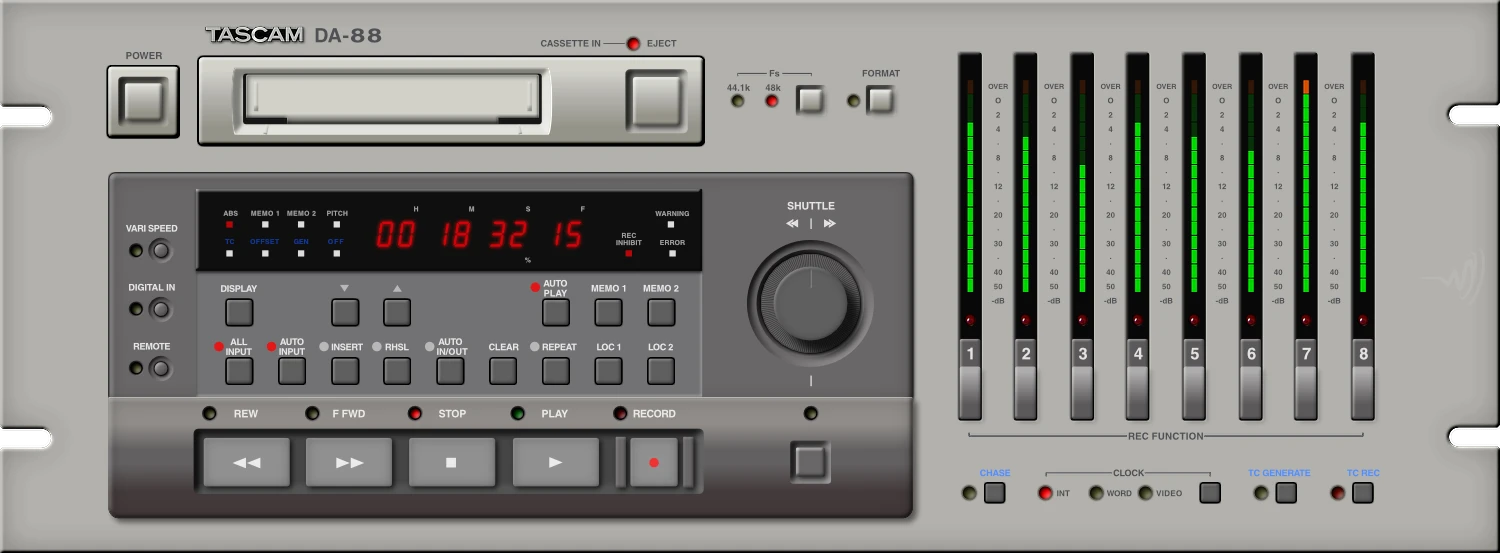
The TASCAM DA-88 was introduced in 1993 and foudn favour in post production suites as well as recording studios.
Synchronisation and expansion
Synchronisation was central to the success of DTRS. A single DA-88 recorded eight tracks, but the system was designed to grow by adding more machines. Up to 16 machines could be connected together for a total of 128 tracks, with sample-accurate synchronisation between decks.
This modular approach changed the economics of multitrack recording. A studio could start with one eight-track recorder and expand later to 16, 24, 32 or more tracks without replacing the original machine. In analogue studios, upgrading track count usually meant buying a larger recorder. With DTRS, the system grew by adding another machine.
The optional SY-88 synchroniser card gave the DA-88 professional timecode capability. With one SY-88 installed in the master machine, a DTRS system could chase SMPTE/EBU timecode, generate and read timecode, use MIDI Machine Control, accept video sync and provide RS-422 control. Timecode was recorded into subcode rather than taking up one of the eight audio tracks, which made the system particularly useful in post-production.
TDIF-1 digital interfacing
DTRS also introduced TASCAM’s TDIF-1 digital interface. TDIF-1 used a bidirectional 25-pin D-sub connector to carry eight channels of digital audio. It allowed digital cloning between DTRS machines and later became important for connecting DTRS machines to digital consoles, digital interfaces and other studio systems.
TDIF-1 was proprietary, but it gave the format a clear professional pathway into digital studio setups. As digital consoles became more common, TDIF allowed DA-series machines to connect without repeated analogue conversion. This was especially useful in facilities building hybrid digital systems around tape-based multitrack recording.
Track delay and editing features
One of the DA-88’s most useful engineering features was individual track delay. Each track could be delayed by up to 150ms at 48kHz. This gave engineers a way to adjust timing and phase relationships between tracks after recording.
Track delay could be used to align bass DI and amplifier signals, tighten drum microphone timing, compensate for microphone distance differences, or align near and far microphone arrays. This was unusual for a tape-based multitrack recorder and gave DTRS users a level of timing control that had previously required external equipment or later workstation editing.
The DA-88 also allowed machine offset for assembly editing, auto punch-in and punch-out, programmable preroll, selectable crossfade times and pitch control. These features helped DTRS function as more than a simple digital replacement for analogue tape.
DTRS System vs ADAT System

The DA-38 and broader access to DTRS
TASCAM expanded the DTRS range with the TASCAM DA-38. The TASCAM DA-38 was a lower-cost machine that remained compatible with the DA-88 format. It recorded eight tracks on Hi8 tape at 44.1kHz or 48kHz, retained the 108-minute recording time and could be used in multi-machine systems. The TASCAM DA-38 removed some of the TASCAM DA-88’s higher-end features. It had no slot for the SY-88 sync card, no stand-alone SMPTE chase capability, no 9-pin Sony P2 serial control and no meter bridge connector. However, it added useful features of its own, including internal track-to-track copying, dither switching, a 440Hz digital tone generator and a numeric block error-rate display. The TASCAM DA-38 was also smaller, lighter and quieter than the DA-88. Its 132mm rack-height chassis and fanless operation made it easier to use in mobile and project-studio environments. It helped make DTRS more accessible while remaining compatible with larger TASCAM DA-88-based systems.

The DA-98 and professional refinement

The DA-78HR and 24-bit DTRS

The DA-98HR and high sample rates

The Sony PCM-800
Why DTRS succeeded
DTRS succeeded because it solved several practical problems at once. It made digital multitrack recording more affordable than large professional digital tape machines. It offered long recording time on compact, relatively accessible media. It allowed systems to expand in eight-track increments. It provided sample-accurate synchronisation between machines. It supported professional timecode workflows. It offered digital interfacing through TDIF. Later, it evolved into 24-bit and high sample-rate recording.
Its strongest markets were project studios, post-production rooms, broadcast facilities, location recording rigs and commercial studios that needed reliable modular digital multitrack recording. The DA-88 in particular became widely used for film, television and video work because it combined long running time, compact media, synchronisation and eight-track delivery in a practical format.
DTRS also reduced the storage burden compared with analogue multitrack tape. A full album project recorded on modular digital tape could occupy a small amount of physical space compared with multiple reels of 2-inch analogue tape. For many studios, this was a major practical and financial advantage.
Where DTRS struggled
DTRS also had weaknesses. It remained a tape-based format, which meant it depended on a complex rotary-head transport. Heads, guides and tape paths needed maintenance. Tape condition mattered. Alignment and tracking were important. The compactness of Hi8 was useful, but it also required mechanical precision.
Formatting was another limitation. Tapes had to be prepared before recording, which added an extra step and created the possibility of accidental erasure if handled incorrectly. DTRS also required proper Hi8 tape, so users could not simply use any cassette that looked similar.
The DA-88’s audio storage method also created a specific risk. Audio was stored as four track pairs: 1-2, 3-4, 5-6 and 7-8. When recording onto one track in a pair, data from the other track in that pair was also involved in the process. This meant an error during an overdub could potentially affect the paired track. Backups were therefore essential for important work.
Cost was another issue. The DA-88 was more expensive than some competing modular digital machines, and a fully equipped DTRS system could require optional sync cards, remotes, meter bridges, TDIF cables, digital interfaces and specialist wiring. DTRS was affordable compared with high-end professional digital multitracks, but it was not always the cheapest route into modular digital recording.
The decline of DTRS
DTRS declined because the recording industry moved away from tape. When the DA-88 arrived, hard disk recording was still expensive and limited. By the late 1990s and early 2000s, digital audio workstations, cheaper storage, improved converters and file-based production were rapidly changing the studio workflow.
Tape-based modular recorders still had advantages in reliability, familiarity and interchange, but the direction was clear. DAWs offered non-linear editing, instant access, visual arrangement, easy copying, file backup and integration with mixing and processing systems.
DTRS remained useful in professional environments for some time, especially where existing tape delivery and post-production workflows continued, but it could not compete indefinitely with file-based recording.