Audio Recorders

Audio Recording formats, encompassing both stereo and multitrack configurations, are essential tools in the creation and preservation of audio content. Stereo recording formats capture two audio channels, typically left and right, providing a simple yet effective method for reproducing sound with spatial accuracy. Stereo formats are commonly used in music production, broadcasting, and consumer audio devices, offering immersive listening experiences across various media platforms.

Multitrack recording formats, on the other hand, enable the simultaneous recording of multiple audio channels or tracks onto a single medium. This allows for the independent manipulation of each track during the mixing and editing process, offering unparalleled flexibility and creativity in audio production. Multitrack formats are widely used in professional music studios, film and television production, live sound reinforcement, and podcasting, enabling artists and engineers to craft complex arrangements, add effects, and achieve precise control over the final audio product.

Both stereo and multitrack recording formats have evolved over the years, from analog tape-based audio recorders to digital technologies such as hard disc recording, solid-state recording, and computer-based digital audio workstations (DAWs). These advancements have democratized audio production, making high-quality recording accessible to a broader audience while pushing the boundaries of creativity and innovation in the field of sound engineering and music production.

Decades
Made In Japan
Released in 1984 /
The TEAC X-2000R was a 1984 stereo open-reel tape deck with bi-directional recording and playback, dbx Type I noise reduction, dual capstan transport, automatic location functions, pitch control, and support for 267mm reels.
Made In Japan
Released in 1984 /
The Nakamichi ZX-5 Cassette Deck was a Japanese-made 3-head cassette deck produced from 1984 to 1987, featuring a 3-motor direct drive double capstan transport, Dolby B and Dolby C noise reduction, adjustable bias, Type I, Type II and Type IV tape support, and source or tape monitoring through its 3-head design.
Made In Japan
Released in 1984 /
Introduced in 1984, the Technics RS-B100 combines a three-head recording system, quartz direct-drive dual-capstan transport, manual level and bias calibration, Dolby B, Dolby C, dbx and Dolby HX Pro in a compact electronically controlled cassette deck.
Made In Switzerland
Released in 1985 /
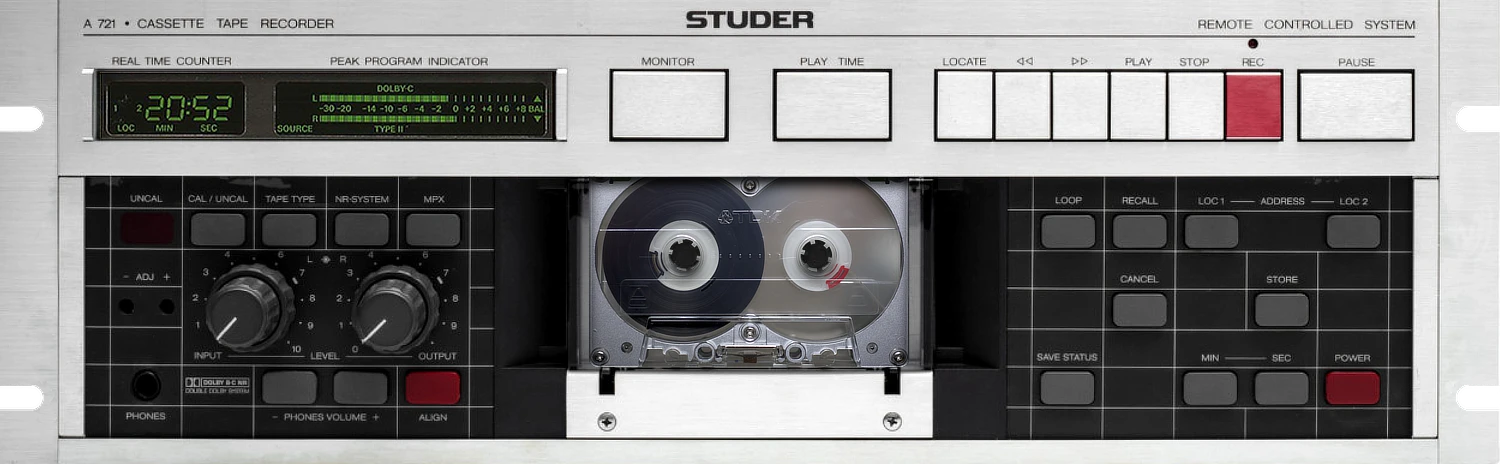
The Studer A721 is a professional cassette recorder with superb audio performance, reliability, and convenient operating concept, including a four-motor tape transport mechanism and modular audio electronics with automatic record parameter calibration.
Made In Japan
Released in 1985 /
The Pioneer CT-A9X is a 3-head stereo cassette deck finished in black, featuring a closed-loop dual-capstan transport, quartz direct-drive capstan motor, ribbon sendust head system, DC amplifier, Dolby B/C noise reduction, MPX filter and Pioneer’s Auto BLE automatic bias, level and equalisation calibration system.
Made In Japan
Released in 1985 /
The Audio-Technica AT-RMX64 was a versatile 1985 recorder mixer that combined a 6-channel mixer with a 4-track cassette recorder in one compact system. With flexible routing, Dolby B and C noise reduction, phantom power, dual-frequency EQ, and the ability to function as both a standalone mixer and multitrack recorder, it was designed as a practical all-in-one solution for live use and demo studio work.
Made In Switzerland
Released in 1985 /
The Studer A820 Multitrack Recorder delivers a processor-controlled analogue multitrack system with modular electronics, precision transport engineering, and extensive synchronisation and configuration capabilities.
Made In Germany
Released in 1985 /
The Revox B 215 Cassette Tape Deck was a high-end cassette machine introduced in 1985, combining Studer/Revox mechanical engineering with advanced microprocessor control. Its four-motor direct-drive transport, automatic tape calibration, Dolby B/C, HX Pro, real-time counter and locator functions made the Revox B215 Cassette Tape Deck one of the most technically complete cassette decks of its generation.
Made In Japan
Released in 1985 /
The Onkyo TA-2090 Cassette Deck was an Integra series three-head, three-motor cassette recorder with dual-capstan drive, Auto Accubias automatic bias setup, Dolby B, Dolby C, dbx noise reduction, Dolby HX-Pro, automatic tape selection, real-time counter, AMCS music search, and extensive front-panel status indication.
Made In Norway
Released in 1985 /
Released in 1985, the Tandberg TCD 910 was a professional three-head, three-motor master cassette recorder with balanced XLR connections, programmable cueing, real-time tape calculation, off-tape monitoring and extensive calibration facilities. Its microprocessor-controlled transport, address memory, search functions and adjustable bias, recording current and azimuth made it suitable for professional recording, broadcasting and cassette mastering applications.
Made In Korea
Released in 1985 /
Introduced in 1985, the SAE C102 was a full-logic, two-head cassette deck featuring Computer Direct-Line circuitry, automatic bias and equalisation, Dolby B and C noise reduction, programmable tape-location modes, Music Search and an electronic elapsed and remaining-time display.
Made In Japan
Released in 1985 /
The Mitsubishi X-850 32-Channel Digital Recorder provided a 32-channel digital multitrack system with ProDigi compatibility and integrated synchronisation features, built on a transport design derived from the Otari MTR90 Mk II and widely used in professional studio environments.