
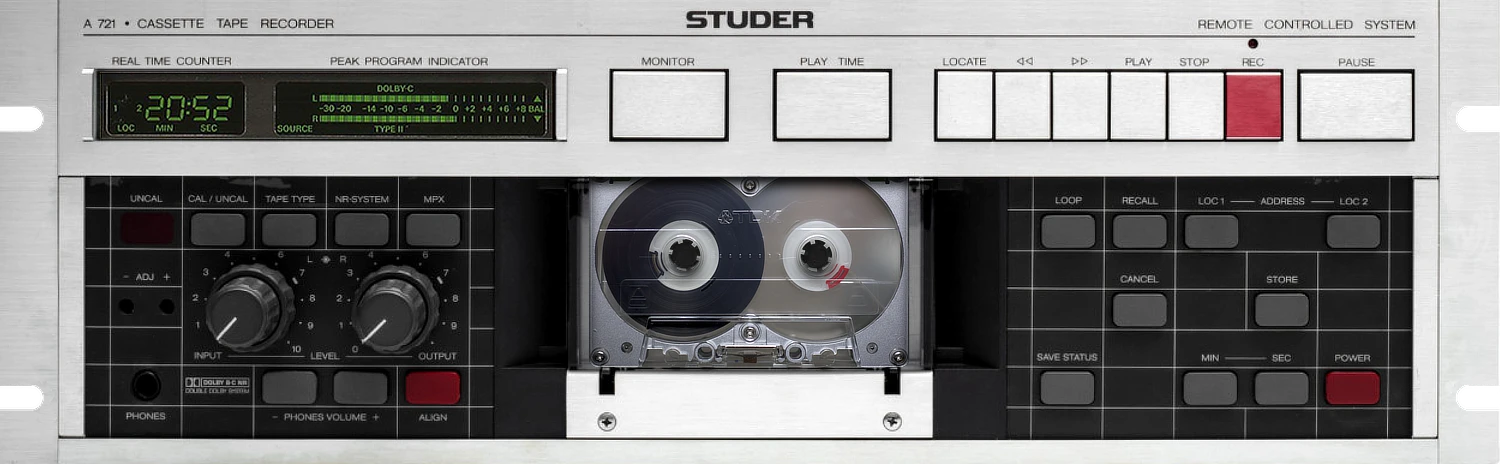
The practical cassette has gained widespread acceptance as a recording medium in the professional audio engineering industry, whether it’s for OB applications, disc recording, or AV studios. Professional users demand exceptional audio performance, reliability, consistent performance to specifications, and stability for continuous use, and these qualities are also expected of cassette recorders. Studer has met all these demands with the development of their Studer A721 cassette recorder.
Its key features include a solid-metal die-cast chassis for enduring precision, a 4-motor direct drive with dual capstan and 2 DC spooling motors, microprocessor control for gentle tape processing and ease of use, a tape counter with digital real-time indication, modular audio electronics with automatic record parameter calibration, a peak program meter with backlit LCD bar graph instruments, standard equipment for switching between DOLBY B and C, tape/source monitoring, and balanced inputs and outputs (both calibrated and uncalibrated). It is also suitable for 19″ rack mounting.
The tape transport technology of the Studer A721 exemplifies the high standards of precision and stability set for the entire unit. Precision is crucial for achieving excellent audio quality, particularly when dealing with narrow tapes. Stability is also essential for a unit designed for constant professional use. Despite meeting these basic requirements, the A721 offers additional performance capacity.
Its tape deck chassis and headblock assembly are made of rigid die-cast aluminium alloy. The four-motor tape transport mechanism includes two direct-drive fast responding spooling motors and two high-precision disc rotor motors for dual capstan direct drive. All transport functions are managed by microprocessors.
The Studer A721 is exceptionally user-friendly, contributing to its reliability and enabling efficient use of its comprehensive function repertoire. Large-surface keys are provided for the primary tape deck functions, ensuring fast and error-free operation. The logical arrangement of the secondary controls for the audio electronics and tape transport control allows users to take full advantage of the wide range of programmable auxiliary functions.
The well-arranged LC display is easy to read under any lighting conditions and provides continuous and comprehensive information on real-time tape position, output level, operating modes, and machine states.
The Studer A721’s audio electronics have been designed to deliver exceptional performance and can be used with any type of tape. The calibration process is simple and efficient, with the calibration computer performing all necessary functions. Audio parameters specific to a batch of tapes can be stored and retrieved automatically, and the input and output levels can be calibrated to nominal studio level or adjusted individually for each channel.
The tape/source monitoring switch can be operated manually or by control logic. The DOLBY B and C noise reduction systems can be activated with the touch of a button, along with switchable FM pilot tone suppression (MPX).
The Studer A721’s tape deck control is designed for ease of use, with any operating mode easily activated directly from any machine state. The computer takes care of smooth transitions, such as fast fade-in and fade-out in record mode. Locator functions are available for quickly finding a specific address, and two addressable locator registers allow for quick access to any two tape locations or for repetitive playing of a program sequence.
The current tape address can be entered by pressing the STORE key, or any location can be keyed in using MIN-SEC. The register contents can be easily read off the display, cancelled, or overwritten.
The Studer A721 is equipped with a 25-pin D-type connector for parallel remote-control interface, which supports fader start and remote-control operation of all primary tape deck functions with visual status feedback. It also features balanced and floating XLR inputs and outputs for optimal connectivity.
Features
- Type: 3-head, single compact cassette deck
- Track System: 4-track, 2-channel stereo
- Heads: 1 x combination record/playback, 1 x erase
- Motor: 2 x reel, 2 x capstan
- Tape Type: type I, CrO2, Metal
- Noise Reduction: B, C
- Tape deck:
- 4-Motor tape transport
- 2 Computer-controlled DC motors
- 2 Individually controlled direct-drive capstan motors
- Tape counter: Real-time indication in min./sec. based on preselected cassette play time
- Locator functions:
- 2 User-definable/erasable addresses
- Supports loop function
- Additional working address for LOCATE function
- Level meter: Peak program indicator, 200 nWb/m at 0 dB mark

