
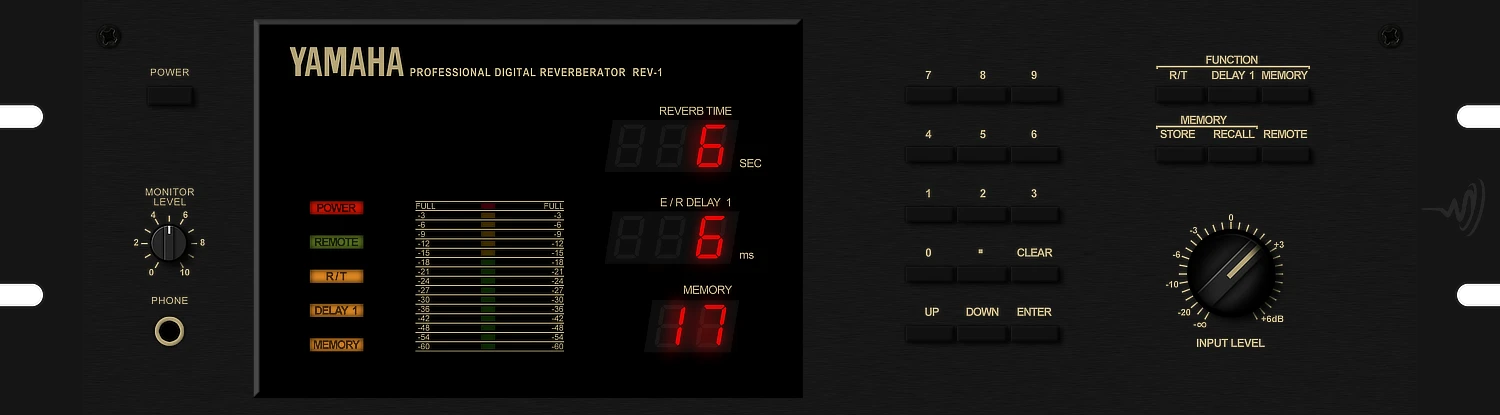
The main unit provided front panel adjustments for input-level controls, monitoring, and the 16-LED input display, as well as dedicated RT60 and early reflection time displays. The rear panel covered the full professional feature set: balanced XLR input and output, remote and RS232C computer interface, external word-clock input, and switching between analogue and optional 16-bit digital input. Although the unit could technically operate from its own front panel, the remote control was the heart of the system, and opening it up revealed an interface that looked complex at first glance but proved surprisingly logical in practical use.
Remote Controller And Workflow
The remote divided parameter control into four fundamental sections, covering reverb quality, early reflections, reverb delay, and memory functions. With 30 ROM presets and 60 RAM memories in the main processor, plus an additional nine in the remote’s internal memory, the Yamaha REV1 offered a level of storage and recall flexibility uncommon at the time. Many early presets were labelled for specific plate and percussion applications, and the ROM also included more unusual effects such as stereo echo, flange, tremolo, chorusing, and constant-density plates. Any preset could be moved into RAM, edited in detail, and saved for future use.
Early Reflection Design
Early reflections were a major focus of the design, and the Yamaha REV1 separated them from the main reverb algorithm in a way that gave engineers unusual precision. The unit offered an early reflection number control with eight distinct patterns, room-size selection in eight steps, and a liveness control with eight settings. Delay before the onset of reverberation ranged from zero to 600 milliseconds. Unlike many simpler reverbs that treated early reflections and decay as a single block, the Yamaha REV1 allowed them to be shaped independently, which contributed significantly to its realistic spaces when programmed with care.
Operator feedback from the era emphasised how the LCD made parameter adjustments fast and intuitive. The waveform view gave a visual representation of early reflection structure, the filter and crossover displays helped align reflections with the direct signal, and the reverb time and ratio displays provided a clear view of decay behaviour across low, mid-low, mid-high, and high-frequency bands. An Auto mode gave an averaged interpretation of the machine’s internal relationships between settings, helping users find a starting point without guesswork.
The remote’s software workflow was also seen as unusually forward-thinking. Changing parameters, adjusting values, saving presets, and recalling setups were all handled in a direct and predictable manner. A full 16-segment LED meter on the remote showed input and output levels, while filters and crossovers were given their own switches. Primary reverberation time was adjustable from 0.1 to 99.9 seconds, with clear increments for fine control in each band. The RT60 section included ranges for low, mid-low, mid-high, and high-frequency decay, each with its own selectable crossover frequencies.
Reverb Modes And Parameter Control
The REV mode section offered eight internal reverb types, ranging from Super High Density and High Density to several density variations and an equally spaced diffusion algorithm. Each mode could be shaped with three dedicated knobs for high, mid-high, and low decay levels. Additional keys controlled delay before reverb, mixing level between direct and processed sound, and early reflection options.
User Experience And Editing Depth
Hands-on user impressions from the period were mixed in interesting ways. Engineers admired the sound quality of its plates, halls, and constant-density reverbs, while also noting that some of the special effects felt more like curiosities than essential tools. Many users found that the realism of its room sounds improved significantly once they began adjusting the early reflection mode and delay patterns rather than relying solely on presets. The remote’s ability to tailor reflections relative to the direct signal made the unit particularly effective on percussion, vocals, and natural ambience work.
Other engineers noted limitations. Some expected deeper modulation and special effects control than the Yamaha REV1 offered, especially given its premium positioning. Others felt the unit’s response could be slightly electronic or “shifty” when pushed, although this could be mitigated by careful editing of the E/R mode resolution. Still, most agreed that once a sound was dialled in precisely, the unit delivered a smooth and pleasing reverb that blended well in mixes of the time.
Memory And System Integration
The remote allowed users to store their own versions of edited presets, with memory functions that supported storing, recalling, copying, and naming. The non-volatile memory preserved settings when the unit was powered down, and Yamaha even anticipated studio needs by making space for a potential user-preset download system via the RS232C interface and external computer, although few studios ever used this capability extensively.
At the bottom of the remote, the master controls allowed the user to blend the reverberated signal with the direct source and early reflections. Separate keys controlled RT, delay, reverb level, master on and off, and memory access, while the LCD displayed E/R structure, RT60 behaviour, and crossover points. In the right hands, this allowed the configuration of complex spaces, gated reverbs, doubling effects, or clean natural ambience.
The Yamaha REV1 is an early example of deep digital reverb design, combining detailed parameterisation with a user interface that pushed beyond the limitations of most rack units of its era. While modern reverbs eventually surpassed it in resolution and sophistication, the Yamaha REV1’s structure remains surprisingly advanced. Its blend of separate early-reflection processing, extensive decay shaping, and graphic parameter feedback makes it a unique creative tool even now. Many of its strengths were rooted not only in its algorithms but in Yamaha’s understanding that reverb is a combination of reflections, density, delay, and spectral shaping, and that giving engineers full control over these elements would set the unit apart.
