The Yamaha Rev1 was a highly refined professional digital reverberator designed to deliver exceptional performance across a wide range of professional audio environments, including concert halls, recording studios, broadcast facilities and sound reinforcement systems. It was a system developed with precision and versatility in mind, capable of recreating highly realistic acoustic spaces through detailed control of both early reflections and subsequent reverberation.
The Yamaha Rev1 achieved a frequency response from 20 Hz to 18 kHz, with distortion remaining below 0.03 percent and a dynamic range of 85 dB when operating in reverb mode. Central to its operation were Yamaha’s proprietary large-scale integration signal processing chips, working in combination with an onboard micro-computer to manage reverb algorithms. This architecture allowed up to 40 early reflections per channel (left and right) to be independently programmed and controlled. The resulting simulations were capable of faithfully replicating complex natural acoustic environments.
The Yamaha Rev1 also included a dedicated remote-control unit, which offered in-depth control over direct sound, early reflections and subsequent reverberation. The early reflection section featured eight selectable modes, with initial delay settings adjustable up to 600 milliseconds in 1 millisecond increments. Users could define room size, set the number of reflections and specify the acoustic absorption coefficient of walls, making it possible to simulate virtually any type of real-world acoustic space.
 For subsequent reverberation, users could also choose from eight available modes, with delay times between direct sound and reverb adjustable up to 600 milliseconds, again in 1 millisecond steps. The overall reverb time could be selected between 0.1 seconds and 99.9 seconds at the mid-low frequency band. Additionally, reverb time could be tailored independently across four frequency bands: high, mid-high, mid-low and low. These capabilities gave engineers unparalleled flexibility in shaping reverberation behaviour.
The Yamaha Rev1 offered extensive memory for storing and recalling reverb programs. It included 30 pre-set ROM memories with names such as “LARGE HALL,” “HAND CLAP,” “PERCUSSION PLATE,” and “CHORUS.” A further 60 RAM memories in the main unit and 9 more in the remote-control unit allowed users to store modified versions of factory presets or completely new user-designed programs, bringing the total number of programmable locations to 69.
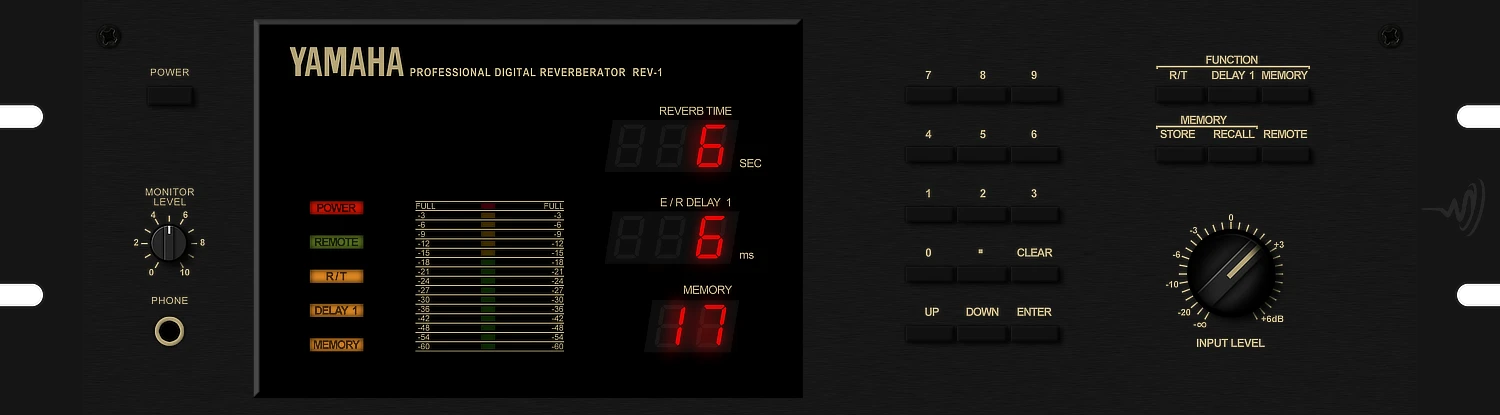
Data entry was facilitated through ten numeric buttons on the main unit, a full numeric keypad on the remote-control unit, as well as UP and DOWN keys. Input was displayed via 3-digit 7-segment LEDs on both the main and remote-control units, with additional visual feedback provided by a high-resolution LCD on the remote unit.
For precision level monitoring, the Yamaha Rev1 featured 16-step LED metering on the main unit, ensuring accurate input setting and supporting the unit’s wide dynamic range. Input monitoring was available on both the main and remote-control units, with the remote also offering output metering. The remote-control unit featured a backlit 64 x 240 dot-matrix LCD display that supported eight different graphical display modes. These included visualisations for waveform and reverb time, displays for Delay 1 and Delay 2, and graphical representations of high and low pass filter characteristics.
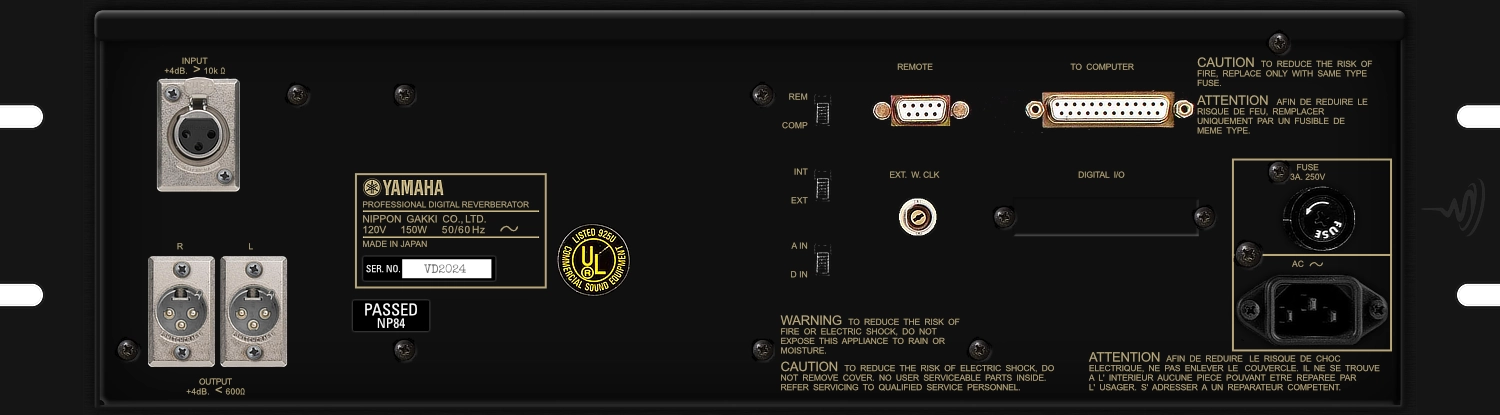
Connectivity options were comprehensive. The Yamaha Rev1 included an RS-232C compatible connector for external computer control, a terminal for an external word clock, and an optional interface for digital audio input and output. Through this combination of sonic precision, detailed programmability and advanced interfacing, the Yamaha Rev1 stood out as one of the most advanced digital reverb systems of its time.
Features
- Frequency response from 20 Hz to 18 kHz
- Distortion below 0.03 percent in reverb mode
- Dynamic range of 85 dB
- Independent control of up to 40 early reflections per channel
- Eight early reflection modes with 1 msec resolution up to 600 msec
- Adjustable room size, number of reflections and wall absorption coefficients
- Eight subsequent reverberation modes with 1 msec resolution delay time
- Reverb time adjustable from 0.1 to 99.9 seconds at mid-low frequencies
- Four-band reverb time adjustment (high, mid-high, mid-low, low)
- 30 factory presets including LARGE HALL, HAND CLAP, PERCUSSION PLATE and CHORUS
- 60 user RAM memories in the main unit and 9 in the remote-control unit
- Numeric data entry via ten-key pad, UP/DOWN buttons, and 7-segment LED display
- Input level monitoring with 16-step LEDs on both main and remote units
- Remote unit includes 64 x 240 dot-matrix LCD with eight graphical display modes
- Displays include reverb waveforms, reverb times, delay lines and filter settings
- RS-232C computer control terminal for external automation
- External word clock input terminal
- Optional digital I/O interface for integration with digital audio systems