DAT Recorders

DAT Recorders covers domestic hi-fi and professional Digital Audio Tape machines built for high-quality recording and playback in home, studio and broadcast use. Explore classic DAT decks from respected audio manufacturers, including compact home recorders, high-end domestic models and professional machines designed for demanding digital audio production.

Decades
Made In Japan
Released in 1987 /
The Sony DTC-1000ES Digital Audio Tape Deck was the world’s first DAT machine, and although it was a consumer machine, it proved to be very successful in the professional world too, perhaps even more so as DAT never really made it in the consumer world.
Made In Japan
Released in 1987 /
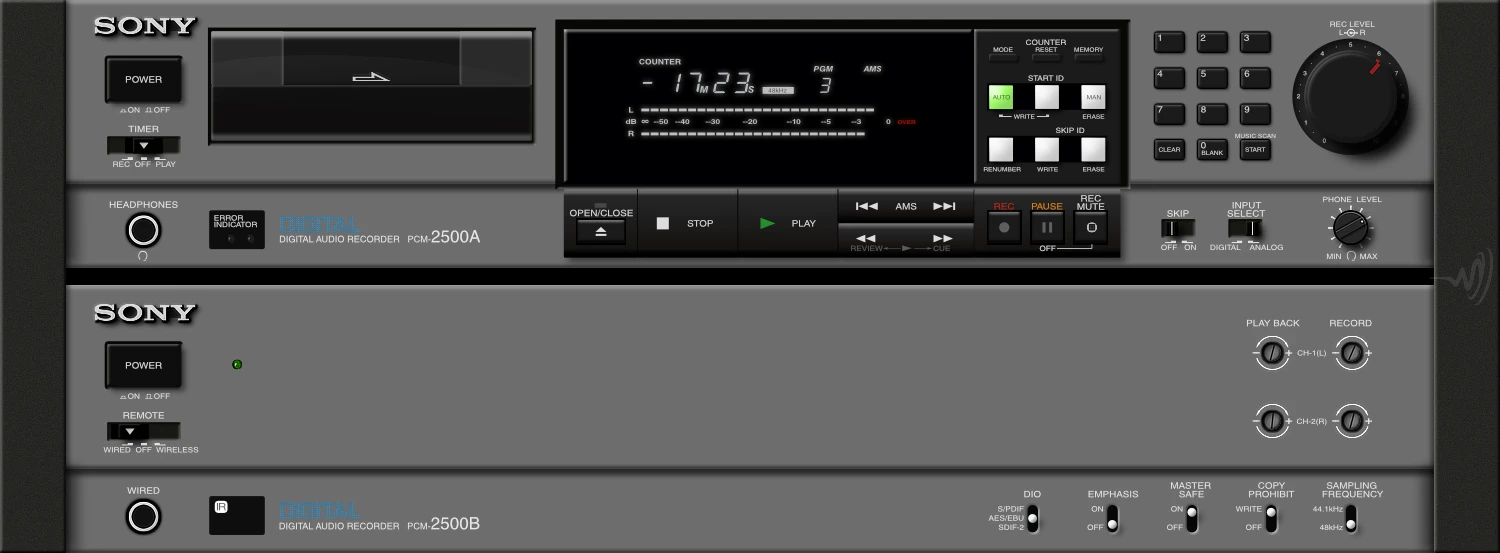
The Sony PCM2500 DAT Recorder took over from the Sony PCM-1630 Series Recorders and kept the DAT format alive for years to come in the studio, (with many successful albums having been mastered to it) but DAT as a format, failed to succeed in the domestic market.
Explore the full Series
Made In Japan
Released in 1987 /
Sony DRD-100 DAT Duplicator is a real-time rack-mount system offering master-quality copying of digital audio and subcode data in up to fifty linked units operating as master or slave with split-use capability.
Made In Japan
Released in 1987 /
The Luxman KD-117 is a 1987 digital audio tape recorder with R-DAT rotary head recording, 16-bit linear conversion, 48kHz and 32kHz recording, coaxial and optical digital connections, advanced subcode functions and a digitally controlled transport system.
Made In Japan
Released in 1988 /
The Sony DTC-M100 is a compact 1988 domestic DAT recorder with 16-bit linear digital recording, 48kHz recording and playback, 44.1kHz playback only, 32kHz digital recording and playback, subcode editing functions, digital peak margin display, optical and coaxial digital input, optical digital output, removable side wood panels and RM-N500 wireless remote control.
Made In Japan
Released in 1988 /
The Sony DTC-500ES is a 1988 ES series DAT deck with 2 fs A/D conversion, 16-bit D/A conversion with 4 fs digital filtering, independent left and right D/A converters, a 2 D.D. + 1 BSL motor transport, optical and coaxial digital input and output, detailed subcode functions, advanced search facilities, digital peak margin display and the RM-N500 wireless remote control.
Made In Japan
Released in 1989 /
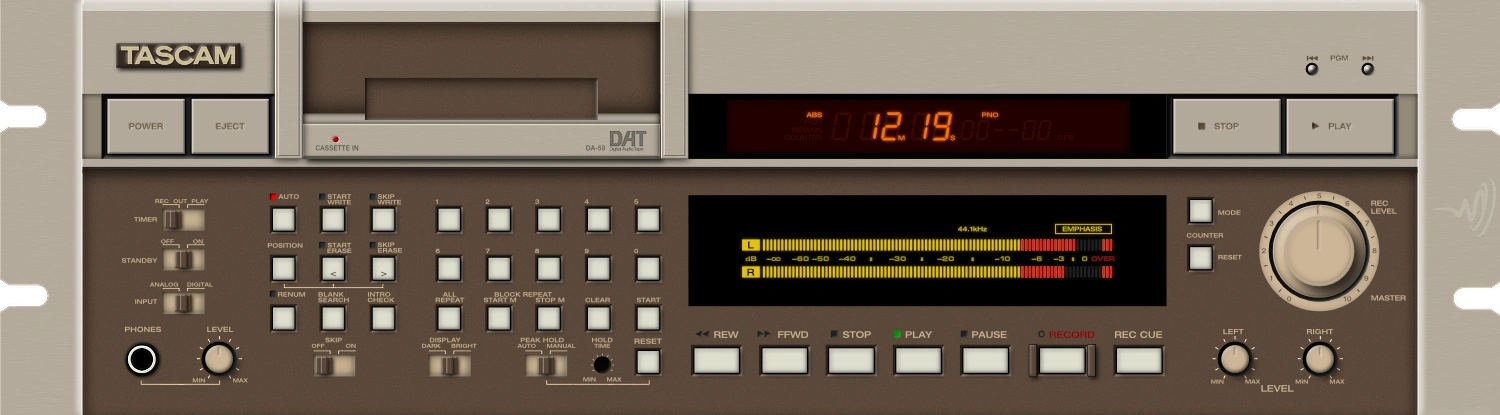
The TASCAM DA-50 Digital Audio Tape Recorder was the first US-legal DAT tape recorder with SCMS Copy protection, it was also a rebadged high-end TEAC or in Japan, Esoteric DAT recorder with some cosmetic changes to suit professional studio use.
Explore the full Series
Made In Japan
Released in 1989 /
The JVC XD-Z1010 DAT Recorder was a Japanese-made Digital Audio Tape deck produced from 1989 to 1996, offering 2-channel stereo DAT recording, 48kHz, 44.1kHz and 32kHz sampling frequencies, rotary heads, 18-bit D/A conversion, 1-bit 64-times oversampling A/D conversion, and coaxial and optical digital connectivity.
Made In Japan
Released in 1989 /
The Panasonic SV-3500 is a professional DAT recorder combining advanced rotary head technology, 18-bit conversion systems, and comprehensive indexing features to deliver precise digital recording and playback in a compact format.
Made In Japan
Released in 1989 /
The Technics SV-360 DAT Recorder was a Japanese-made rackmount Digital Audio Tape recorder produced from 1989 to 1990, designed for professional and installation use, and documented as being identical in construction to the Panasonic SV-3500.
Made In Japan
Released in 1990 /
The Fostex D-20 DAT Recorder is a professional DAT-based digital master recorder that delivers reliable two-track recording with full timecode and synchronisation support. Combining digital accuracy with analogue-style operation, it became a trusted solution for mastering and programme recording in studios and broadcast facilities during the early professional DAT era.
Explore the full Series
Made In Japan
Released in 1990 /
The JVC XD-Z507 was a domestic DAT recorder manufactured from 1990 to 1995. It supported 48 kHz, 44.1 kHz and 32 kHz recording and playback, included SCMS, Auto ID Edit, optical and coaxial digital connections, 1-bit conversion technology and system control features for use within JVC hi-fi systems.