Audio Recorders

Audio Recording formats, encompassing both stereo and multitrack configurations, are essential tools in the creation and preservation of audio content. Stereo recording formats capture two audio channels, typically left and right, providing a simple yet effective method for reproducing sound with spatial accuracy. Stereo formats are commonly used in music production, broadcasting, and consumer audio devices, offering immersive listening experiences across various media platforms.

Multitrack recording formats, on the other hand, enable the simultaneous recording of multiple audio channels or tracks onto a single medium. This allows for the independent manipulation of each track during the mixing and editing process, offering unparalleled flexibility and creativity in audio production. Multitrack formats are widely used in professional music studios, film and television production, live sound reinforcement, and podcasting, enabling artists and engineers to craft complex arrangements, add effects, and achieve precise control over the final audio product.

Both stereo and multitrack recording formats have evolved over the years, from analog tape-based audio recorders to digital technologies such as hard disc recording, solid-state recording, and computer-based digital audio workstations (DAWs). These advancements have democratized audio production, making high-quality recording accessible to a broader audience while pushing the boundaries of creativity and innovation in the field of sound engineering and music production.

Decades
Made In Japan
Released in 1987 /
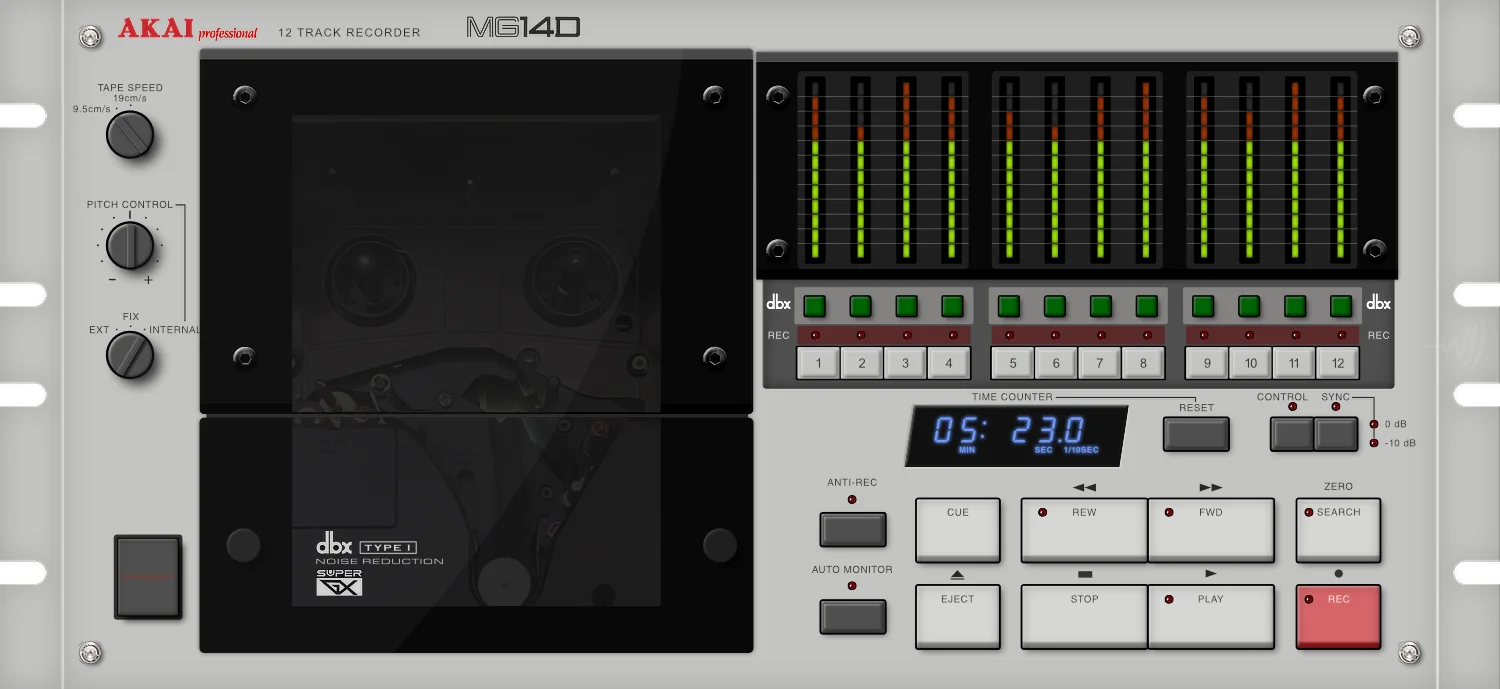
One of the most unusual tape recorders released during the golden period of the 1980s, is without a doubt, the Akai MG14D, a tape based analogue recorder that offered excellent sound quality in a relatively compact chassis, released hot on the heels of a wave of digital multitrack recorders.
Made In Japan
Released in 1987 /
The Akai MG614 Recorder was a high-end cassette multitrack recorder and mixer offering four audio tracks plus a dedicated sync signal on track 1. With a six-channel mixer, twin parametric EQs, dbx noise reduction, dual tape speeds, and a built-in auto locator, it delivered professional features for serious home recording. Designed for seamless MIDI integration and efficient workflow, it was a powerful tool for musicians committed to four-track production.
Made In Japan
Released in 1987 /
The Luxman KD-117 is a 1987 digital audio tape recorder with R-DAT rotary head recording, 16-bit linear conversion, 48kHz and 32kHz recording, coaxial and optical digital connections, advanced subcode functions and a digitally controlled transport system.
Made In Japan
Released in 1988 /
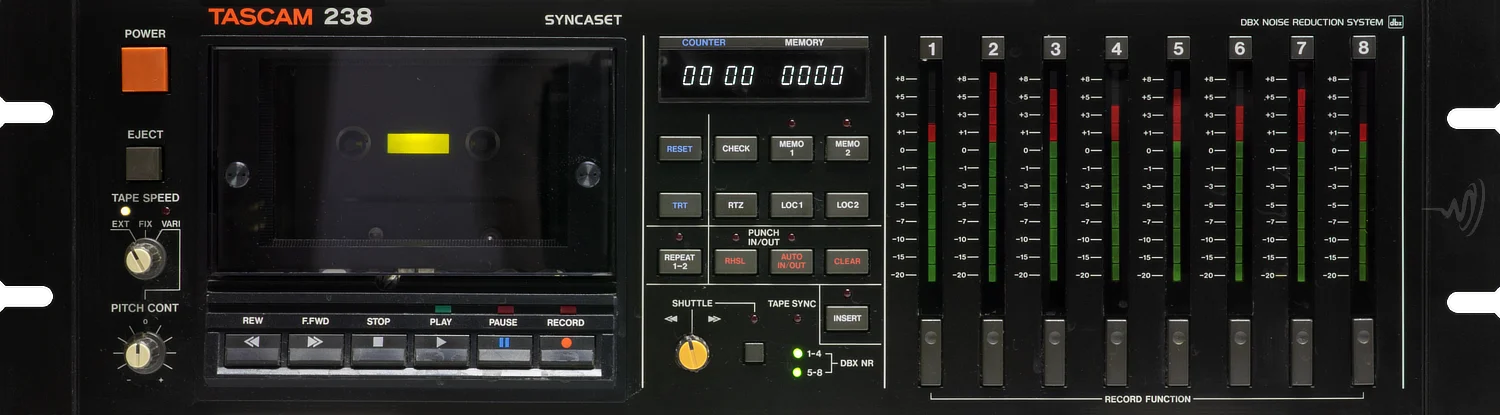
TASCAM, in 1988, pulled off the impossible by releasing the TASCAM 238 Syncaset and cramming 8 tracks onto a single cassette tape, and somehow they got it to work without compromising sound quality.
Made In Japan
Released in 1988 /
The Sony TC-K333ESR is an ES series cassette deck built around a 3-head layout, closed-loop dual-capstan transport, quartz-locked direct-drive capstan motor and Dolby B/C noise reduction. It combines Sony’s midship drive construction with separate control and audio circuit areas, calibration controls for bias and recording level, a wide-range peak programme meter and Type I, II and IV auto tape selection.
Made In Japan
Released in 1988 /
The Sony DTC-M100 is a compact 1988 domestic DAT recorder with 16-bit linear digital recording, 48kHz recording and playback, 44.1kHz playback only, 32kHz digital recording and playback, subcode editing functions, digital peak margin display, optical and coaxial digital input, optical digital output, removable side wood panels and RM-N500 wireless remote control.
Made In Japan
Released in 1988 /
The Akai GX-95 was a Reference Master three-head cassette deck featuring LC-OFC Super GX heads, a direct-drive closed-loop dual-capstan transport, manual level and bias calibration, Dolby B and C noise reduction, Dolby HX Pro, IPSS programme search and wireless remote control.
Made In Japan
Released in 1988 /
The Sony DTC-500ES is a 1988 ES series DAT deck with 2 fs A/D conversion, 16-bit D/A conversion with 4 fs digital filtering, independent left and right D/A converters, a 2 D.D. + 1 BSL motor transport, optical and coaxial digital input and output, detailed subcode functions, advanced search facilities, digital peak margin display and the RM-N500 wireless remote control.
Made In Japan
Released in 1989 /
The Denon DR-70 is a 3-head stereo cassette deck available in black as the DR-70 and champagne gold as the DR-70G. It features a closed-loop dual-capstan transport, Silent Mechanism, ceramic composite cassette stabiliser, amorphous core PC-OCC recording and playback heads, Dolby B/C noise reduction, Dolby HX Pro, bias fine adjustment and a wireless remote control.
Made In Japan
Released in 1989 /
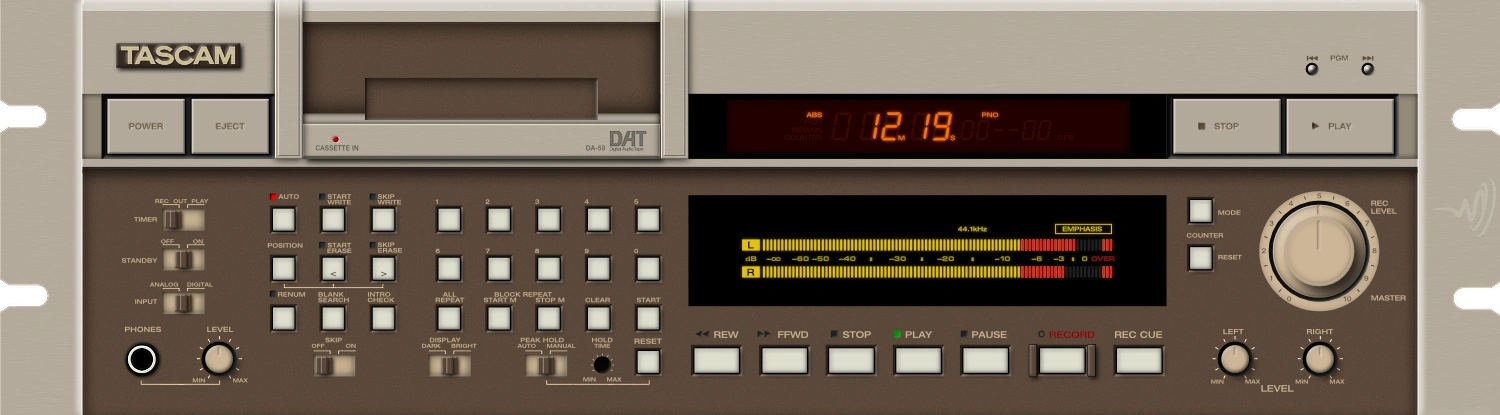
The TASCAM DA-50 Digital Audio Tape Recorder was the first US-legal DAT tape recorder with SCMS Copy protection, it was also a rebadged high-end TEAC or in Japan, Esoteric DAT recorder with some cosmetic changes to suit professional studio use.
Explore the full Series
Made In Japan
Released in 1989 /
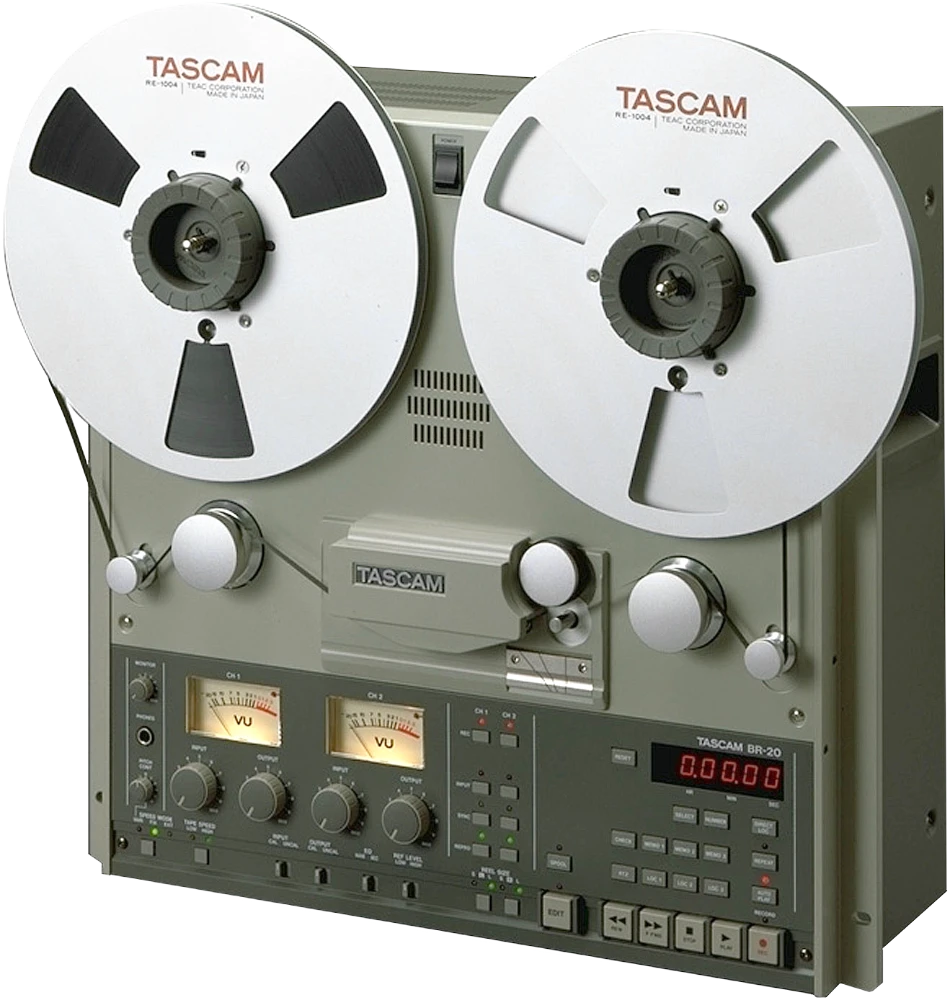
The TASCAM BR-20 and BR-20T were professional 6.35mm analogue 2-track recorder/reproducers designed for broadcast, video post-production and studio use. The BR-20 provided professional analogue recording, balanced interfacing, microcomputer-controlled location functions and precise tape handling, while the BR-20T added a centre/line timecode track for synchronised production work.
Made In Japan
Released in 1989 /
The JVC XD-Z1010 DAT Recorder was a Japanese-made Digital Audio Tape deck produced from 1989 to 1996, offering 2-channel stereo DAT recording, 48kHz, 44.1kHz and 32kHz sampling frequencies, rotary heads, 18-bit D/A conversion, 1-bit 64-times oversampling A/D conversion, and coaxial and optical digital connectivity.