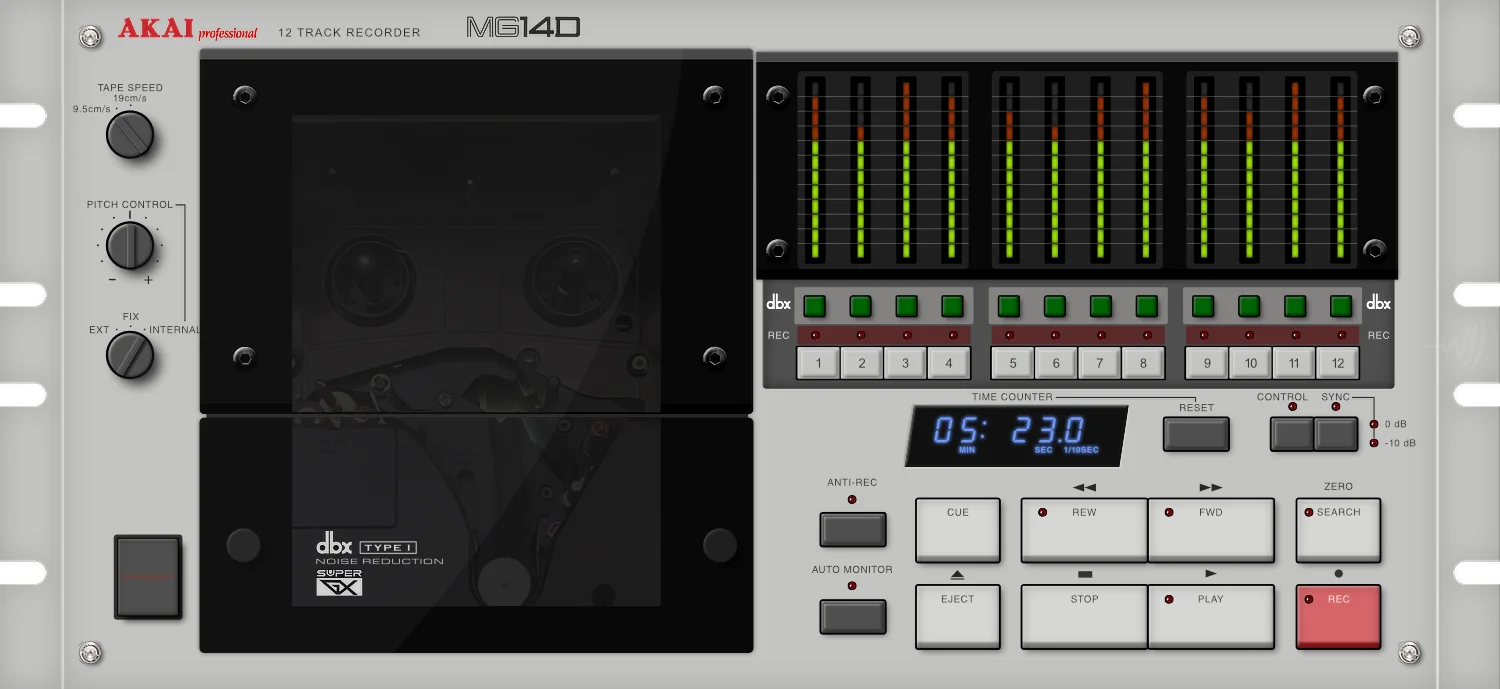
Akai MG14D 12 Track Recorder

Akai MG14D
One of the most unusual tape recorders released during the golden period of the 1980s, is without a doubt, the Akai MG14D, a tape based analogue recorder that offered excellent sound quality in a relatively compact chassis, released hot on the heels of a wave of digital multitrack recorders.

Akai MG14D 12 Track Recorder Details

As the 1980s ended, Akai who were enjoying their time in the sun with the massive success of their range of digital samplers, had turned their attention to recorders. By around 1987 they released the Akai MG14D, a tape-based recorder that was very unique and bespoke. It offered great sound quality with 12 tracks for a reasonable price point. The development had a number of hurdles to overcome but given Akai’s experience in high end consumer tape recorders, they made it work.

The Akai MG14D is a rack mountable tape recorder based on the recorder section of the Akai MG1214 with a dedicated sync and control track which made it suited for use with SMPTE and synchronisation with MIDI devices.

The Akai MG14D’s ability to lock up with SMPTE time code made this flexible compact multitrack also useful as a production tool for video, film, and sound effects assembly in addition to being a powerful music production tool. Adding the Akai ML14 Auto Locator gave you complete remote control over memory search, auto repeat, punch in/out with precision to 1/10the of a second. Memories in the Akai ML14 were retained for up to one week.

Features

  • Uses 1/2 Inch Akai Original Tapes (MK20)
  • Two Tape Speeds, 19 cm/s and 9.5 cm/s
  • A +/- 1% Pitch Control is available
  • DBX Type I noise reduction ensures professional sound quality


During the development phase of the Akai MG14D and its siblings, Akai was planning to use VHS tape to minimise cost of development, however there was a clause in the licensing of VHS which stated that the format could only be used for video products, or so the story goes. This begs the question; how did Alesis manage to use the VHS tape format in the ADAT? Perhaps by the time the ADAT was in development, JVC, the owner of the VHS format, had a change of heart.

Failing to secure VHS tapes for their new machines, Akia approached Sony to see if they could license the Betamax tape format, only to be turned down once again. This left them with one choice, which was to make their own tapes, which is exactly what they did.

The Akai MG14D and its siblings, were great machines, however the tape that Akai made for use on these machines…not so much. These tapes tended to shed the oxide which would cause audio dropouts and fill the machine with the oxide which was not a very good situation. To fix this problem, Akai approached the experts in tape, TDK, and managed to convince them to make the tapes for their systems, which proved to be a far better option and solved the issue of tape shedding.

Akai MK20J

The Akai MG14D Rack Mountable 12 Track Recorder is a high-performance durable rackmount unit ready to stand up to the rigorous demands of multitrack recording. The Akai MG14D represents a new direction in recording versatility with its compact rack mountable design and SMPTE compatibility

It utilises the same high quality Super GX multitrack recording head as used in the MG1214 as well as an improved loading mechanism to give you the same professional performance and operational features found on the Akai MG1214. Bar graph meters display the precise signal level on each recording track.

The Akai MG14D has 12 audio tracks as well as a sync track and an internal control track. With the use of SMPTE time code it is possible to synchronise your audio and video machines together as well as your MIDI based instruments and sequencers. With SMPTE compatibility the Akai MG14D can be used as a production tool for video, film, and sound effects assembly as well as a tool for creative music production in the recording studio. Combined with the matching ML 14 Programmable Auto Locator the capabilities expand into those of a full-fledged professional SMPTE based recording system capable of handling the most demanding work.

The ML 14 represents the state-of-the art in auto locating technology. All transport controls along with record and playback status can be controlled and viewed from the ML 14. In addition to providing you with total remote control of the Akai MG14D, it will add an exciting dimension to the operating capabilities.

Simple push-button operation of the Akai ML 14 Auto Locator’s controls yields such sophisticated computer-assisted functions as memory search, punch-in/punch-out, playback mute, repeat, and more. A ten key program pad lets you manually enter values into one of the memories for later recall. The memories in the ML 14 will be retained for as long as one week. The memory time and the time count are displayed on a highly visible 5-digit FL display.

While the Akai MG14D may be forgotten, you have to give Akai some credit for developing such a system, at the time they did, with digital recorders just around the corner. The Akai MG14D was a very well designed, and good sounding system, that is sadly all but forgotten.

Specifications

Released in: 1987
Made in: Japan
  • Tape Format: ½ inch Akai original cassette tape (MK20)
  • Track Format: 14-track, 12-channel including 1 control track and 1 sync track
  • Head Configuration: Super GX recording/playback head (1), control head (1), erase head (1)
  • Record Level Calibration: 0 dB referenced to 200 nWb/m of tape flux
  • Tape Speeds: 19 cm/s and 9.5 cm/s
  • Tape Speed Accuracy: ±0.2% (19 cm/s and 9.5 cm/s)
  • Pitch Control Range: ±12% of standard speed
  • Recording Time: 10 minutes at 19 cm/s; 20 minutes at 9.5 cm/s
  • Wow And Flutter: 0.03% RMS, ±0.05% peak at 19 cm/s (DIN/IEC weighted); 0.04% RMS, ±0.06% peak at 9.5 cm/s (DIN/IEC weighted)
  • THD (315 Hz, dbx On): 0.5% at 0 dB (19 cm/s); 0.8% at 0 dB (9.5 cm/s)
  • Maximum Recording Level: +12 dB at 315 Hz (3% third harmonic distortion, dbx On) at 19 cm/s and 9.5 cm/s
  • Fast Wind Time: Approximately 120 seconds
  • Dynamic Range: 115 dB at 1 kHz (dbx On, 19 cm/s and 9.5 cm/s); 95 dB (dbx Off)
  • Noise Reduction: dbx Type I
  • Frequency Response (dbx On): 50 to 20,000 Hz at 19 cm/s; 50 to 16,000 Hz at 9.5 cm/s
  • Frequency Response (dbx Off): 30 to 20,000 Hz at 19 cm/s; 50 to 16,000 Hz at 9.5 cm/s
  • Sync Track Frequency Response: 30 to 16,000 Hz at 19 cm/s; 50 to 8,000 Hz at 9.5 cm/s
  • Signal To Noise Ratio (dbx On): 95 dB (NAB A-weighted, 315 Hz, 3% third harmonic distortion)
  • Signal To Noise Ratio (dbx Off): 60 dB (NAB A-weighted)
  • Crosstalk: 70 dB main track, 1 dB sync track at 19 cm/s; 65 dB main track, 1 dB sync track at 9.5 cm/s (dbx Off)
  • Erasure: 75 dB at 125 Hz (dbx On); 52 dB (dbx Off)
  • Motor Configuration: 1 FG servo DC capstan motor, 1 coreless DC reel motor, 1 DC loading motor
  • Input Impedance (Unbalanced): 50 kΩ
  • Nominal Input Level (Unbalanced): −10 dBV
  • Maximum Input Level (Unbalanced): +15 dBV
  • Input Impedance (Balanced): 10 kΩ
  • Nominal Input Level (Balanced): +4 dBu
  • Maximum Input Level (Balanced): +23 dBu
  • Sync Input Impedance: 50 kΩ
  • Sync Nominal Input Level: −10 dBV
  • Sync Maximum Input Level: +15 dBV
  • Output Impedance (Unbalanced): 100 Ω
  • Nominal Output Level (Unbalanced): −10 dBV
  • Maximum Output Level (Unbalanced): +15 dBV
  • Output Impedance (Balanced): 100 Ω
  • Nominal Output Level (Balanced): +4 dBu
  • Maximum Output Level (Balanced): +23 dBu
  • Sync Output Impedance: 100 Ω
  • Sync Nominal Output Level: −10 dBV
  • Dimensions: 225mm x 482.6mm x 430mm
  • Weight: 26 kg
See All: Products
User Reviews

Akai MG14D 12 Track Recorder User Reviews

Gut und zuverlässig (Good and reliable)

By Reinhard Trost

Sound Quality 95%
Build Quality 95%
Usefullness 90%
Mojo/Funk 70%
Reliability 90%

Ich habe nur kurz damit gearbeitet, ca. 3 Jahre. Ich war immer super zufrieden – vor allem mit der Tonqualität. Auch das Handling mit dem Autolocator war einfach und zuverlässig. Hat mit dem synchronisierten PC immer super funktioniert. Ich denke ich werde die Maschine jetzt wieder reaktivieren.

I only worked with it briefly, about 3 years. I was always very satisfied – especially with the sound quality. The handling with the autolocator was also easy and reliable. It always worked perfectly with the synchronised PC. I think I’ll reactivate the machine again now.

Akai tape transfers

By TP

Sound Quality 95%
Build Quality 90%
Usefullness 85%
Mojo/Funk 95%
Reliability 70%

I have each version. Akai MG14D, Akai MG 1212 and the Akai MG 1214. I get sent tapes from all over the world to transfer to WAV files. I often find that some tapes have some songs recorded at 9.5cm/s and some at 19.5 cm/sec so I have to stop transfering when I hear a song playing super fast or slow and change the speed to suit and start the transfer again. I am always amazed that for 40 year old tapes, the quality is like it was recorded yesterday.  [email protected]

Great Machine but…

By Gary Jones

Sound Quality 95%
Build Quality 100%
Usefullness 90%
Mojo/Funk 50%
Reliability 80%

When these things came out, I was in a position to be able to use them for a number of recordings and have to say they sounded very good. I used two machines synchronised into a 24-track system and never had an issue. The tapes however are all but impossible to find these days so I would not buy one now, but in their day they were excellent.

Used it? Leave your rating and review.

Akai MG14D 12 Track Recorder Audio Samples

There are no samples available at the moment. If you can help, please contact us.

Akai MG14D 12 Track Recorder Used on these Recordings

Akai MG14D 12 Track Recorder Appears in These Famous Racks

No results found.

Akai MG14D 12 Track Recorder Plugins

Currently no information available…

Further Reading on the Akai MG14D 12 Track Recorder

No results found.

The details provided above are drawn from historical documents like advertising brochures or user manuals. They’re shared without bias or review. This info is given solely for your consideration, helping you gauge its usefulness to you.

Leave a Comment

Your email address will not be published. Required fields are marked *