Audio Recorders

Audio Recording formats, encompassing both stereo and multitrack configurations, are essential tools in the creation and preservation of audio content. Stereo recording formats capture two audio channels, typically left and right, providing a simple yet effective method for reproducing sound with spatial accuracy. Stereo formats are commonly used in music production, broadcasting, and consumer audio devices, offering immersive listening experiences across various media platforms.

Multitrack recording formats, on the other hand, enable the simultaneous recording of multiple audio channels or tracks onto a single medium. This allows for the independent manipulation of each track during the mixing and editing process, offering unparalleled flexibility and creativity in audio production. Multitrack formats are widely used in professional music studios, film and television production, live sound reinforcement, and podcasting, enabling artists and engineers to craft complex arrangements, add effects, and achieve precise control over the final audio product.

Both stereo and multitrack recording formats have evolved over the years, from analog tape-based audio recorders to digital technologies such as hard disc recording, solid-state recording, and computer-based digital audio workstations (DAWs). These advancements have democratized audio production, making high-quality recording accessible to a broader audience while pushing the boundaries of creativity and innovation in the field of sound engineering and music production.

Decades
Made In Japan
Released in 1982 /
The Hitachi D-2200M is a 1982 3-head stereo cassette deck with a champagne front panel, black display section and computer-controlled recording features. It includes Hitachi’s ATRS automatic tape response system, Hitasenrite head technology, Dolby B/C noise reduction, a Unitorque direct-drive motor, fluorescent digital metering, four tape-type selection and support for normal, CrO2, FeCr and metal cassette tapes.
Made In Korea
Released in 1982 /
Introduced in 1982, the SAE C101 was a three-head, two-motor cassette deck featuring Direct-Line audio circuitry, full-logic transport control, programmable Auto Play, Dolby B and C noise reduction, four-position tape selection and separate bias and level calibration.
Made In Japan
Released in 1983 /
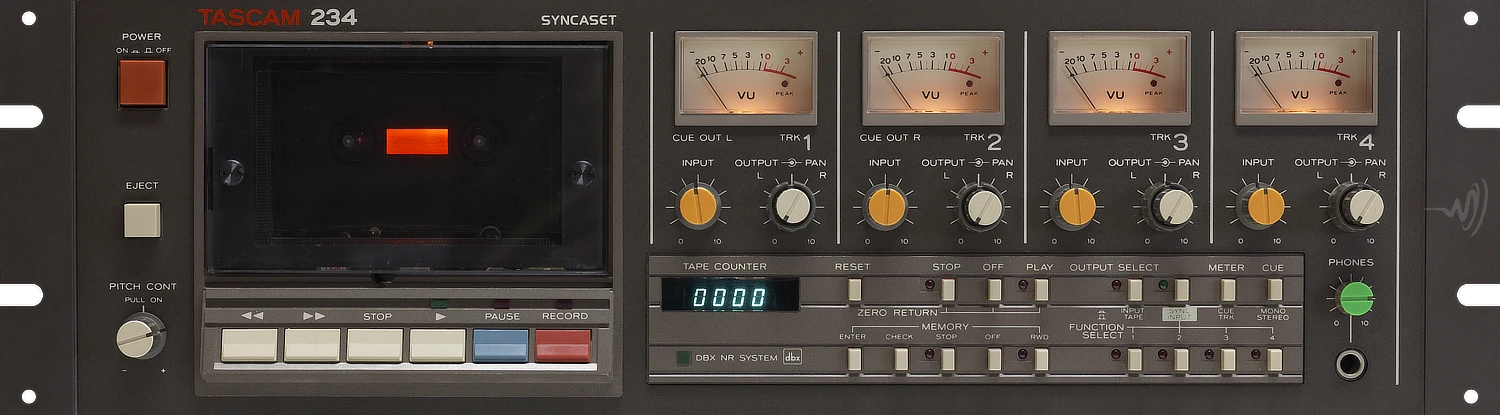
The TASCAM 234 Syncaset 4-channel cassette deck was a groundbreaking audio recorder based on the Portastudio transport, that was introduced in 1983. It failed to achieve the wide acceptance of the all mighty Portastudio however.
Made In Japan
Released in 1983 /
The JVC DD-VR9 was an advanced 1983 auto-reverse cassette deck that combined three-head recording and monitoring, JVC’s U-Turn quick auto-reverse system, direct-drive Pulse Servo transport, B.E.S.T. computerised tape tuning, Dolby B/C noise reduction and a digital peak memory display. Its design focused on making cassette recording more accurate and automated while retaining detailed manual control through a motor-driven slide-out panel.
Made In Norway
Released in 1983 /
The Tandberg TCD 3014 was a three-head stereo cassette deck released in 1983 with a four-motor servo-controlled transport, dual-capstan tape path, microprocessor operation, Dolby B and C noise reduction, Dyneq headroom extension, Actilinear II recording electronics and manual tape-calibration facilities. Its peak-reading meters, source-and-tape monitoring, real-time counter, search functions and optional remote control provided extensive recording and operating control.
Made In Japan
Released in 1983 /
The Luxman K-05 Cassette Deck was a 1983 stereo cassette deck featuring Luxman’s GT dual capstan transport, CTS Computer Tuning System, Direct Drive FG Servo DC capstan motor, combination record/playback head and automatic tape calibration.
Made In Japan
Released in 1983 /
The JVC DD-V7 was a U-Turn auto-reverse cassette deck with a direct-drive Pulse Servo capstan motor, three-motor transport, SA Sen-Alloy record/playback head, Dolby B and Dolby C noise reduction and a digital multi-function counter. Its fast Flip Reverse Swivel Head System, 0.4-second reverse action, music search functions and full-logic transport made it one of JVC’s more advanced convenience-focused cassette decks of the early 1980s.
Made In Japan
Released in 1983 /
The JVC DD-V9 was an auto-reverse, three-head stereo cassette deck with quick reverse operation, Pulse Servo direct drive, B.E.S.T. automatic tape tuning, Dolby B and Dolby C noise reduction and a four-mode digital multifunction counter. It offered two-sided automatic recording and playback while retaining record monitoring, making it a notable JVC cassette deck for users wanting both convenience and recording control.
Made In Switzerland
Released in 1983 /
The Studer A810 Recorder was a compact, modular, and digitally controlled professional tape recorder designed for high-end studio use. With programmable audio parameters, precision tape transport, SMPTE time code capability, and full remote integration, it offered unmatched flexibility, reliability, and sound quality for multi-role recording, editing, and synchronisation tasks.
Made In Japan
Released in 1984 /
The Nakamichi RX-303 is a 2-head unidirectional auto-reverse cassette deck released in 1984. It uses Nakamichi’s UDAR cassette-reversal system, allowing the cassette itself to be turned over while the tape continues to run in one direction, avoiding the bidirectional azimuth errors normally associated with conventional auto-reverse cassette decks.
Made In Japan
Released in 1984 /
Upon its release, the Fostex B-16 Multitrack Tape Recorder gave smaller project studios access to a 16-track tape machine that delivered both performance and affordability for the first time. This marked a significant milestone in home and project studio recording, as the B-16 offered professional-grade multi-tracking capabilities at a fraction of the cost of larger studio machines. With its compact design and reliable sound quality, it allowed independent musicians and producers to create more sophisticated recordings without relying on expensive commercial studios, contributing to the rise of home-based music production in the 1980s.
Made In Japan
Released in 1984 /
The Nakamichi RX-505 is a high-end auto-reverse cassette deck released in 1984. It used Nakamichi’s UDAR system to physically reverse the cassette rather than reverse tape travel across the heads, allowing true unidirectional tape movement, a discrete 3-head layout, dual-capstan transport and auto-reverse recording and playback without the usual azimuth compromise.