Roland

Roland is best known for its legendary keyboards, but it also has a rich history in digital effects processors. Starting with early tape delays like the RE-201 in the 1970s, Roland’s innovation continued into the digital era with the SDE-2000 digital delay and the iconic SDD-320 Dimension D Chorus in 1981. Over the years, they introduced standout products such as the SRV-2000 reverb, famous for its characterful sound and use by Slash on “Sweet Child of Mine.” Roland’s attempt at high-end studio reverb with the R880 met limited success, leading them to focus on more affordable processors. The SRV-330 dimensional reverb and SDE-330 space delay are highly regarded, while the rare SDX-330 dimensional expander is famed for its superior chorus effects. Their final unit, the SRV-3030, was less successful and often confused with the well-regarded SRV-330, but they remain distinct products in Roland’s diverse effects legacy.

Roland RE-201
Roland SDD-320 Dimension D
Decades
Made In Japan
Released in 1985 /
The Roland SDE-2500 Digital Delay came after the Roland SDE-3000 and coincided with the release of the equally excellent Roland SRV-2000 Digital Reverb.
Explore the full Series
Made In Japan
Released in 1985 /
The Roland TR-727 was a Latin percussion drum machine with 15 PCM-sampled sounds, designed as a companion to the TR-707. Its agogôs, congas, timbales and cabasas helped shape early house, techno and acid house, giving electronic music new textures that remain influential today.
Explore the full Series
Made In Japan
Released in 1986 /
Roland proudly introduced a new standard in signal processors the Roland DEP-5 Digital Effects Processor. The Roland DEP-5 incorporates Roland’s most advanced digital technology for great sound and easy programming. Roland digital effects devices are the choice of musicians and engineers the world over. Onstage and in studios, the remarkable SRV series digital reverb units and SDE series digital delays play a vital role in today’s music.
Made In Japan
Released in 1987 /
Released in 1987, the Roland D-50 Linear Digital Synthesizer was Roland’s first fully digital synthesiser and introduced LA synthesis, combining PCM sound components with programmable digital synthesis. Its 32-Partial architecture, seven Structures, integrated digital equalisation, chorus and reverb, 64 internal Patches, Memory Card expansion and velocity and pressure-sensitive 61-key keyboard placed sound generation, processing and performance control within a single instrument. The Roland D-50 became one of the defining digital synthesisers of the late 1980s and helped establish the combination of sampled and synthesised sound generation that became central to later digital instruments. 
Made In Japan
Released in 1987 /
The Roland S-550 is a 16-bit rackmount digital sampler released in 1987, offering expanded features over the S-50 keyboard version. It provides 16-voice polyphony, up to 2.0MB memory (allowing 28.8 seconds of sampling at 15kHz), and eight individual outputs for flexible routing. The S-550 includes a 3.5-inch Quick Disk drive and supports Roland’s extensive sound library. Its standout feature is an RGB monitor output with graphical editing via the optional RC-100 remote and mouse.
Made In Japan
Released in 1987 /
The Roland GP-8 Guitar Effects Processor offers eight programmable effects, customisable patches, and easy control via the optional FC-100 Foot Controller. With user-friendly features like the Alpha-Dial and back-lit LCD, it’s ideal for live and studio use.
Explore the full Series
Made In Japan
Released in 1988 /
The Roland E-660 is a versatile two-channel digital equaliser with eight filters for precise sound adjustments, offering flexible configurations and intuitive controls, along with delay capabilities and extensive connectivity options.
Made In Japan
Released in 1989 /
In 1989 Roland decided it was time to take on the big names in studio reverbs, and they released their best reverb to date, the Roland R-880. As good as the Roland R-880 was, and is, it failed to take any market share away from the big names like Lexicon, but it did find a home in some studios and those people love the Roland R-880.
Made In Japan
Released in 1989 /
The Roland GP-16 was a pioneering digital guitar multi-effects processor that combined 16 high-quality digital effects, flexible routing, MIDI control, and professional connectivity. It was acclaimed for its sound quality, versatility, and reliability, becoming a favourite among professional guitarists in both live and studio contexts.
Explore the full Series
Made In Japan
Released in 1991 /
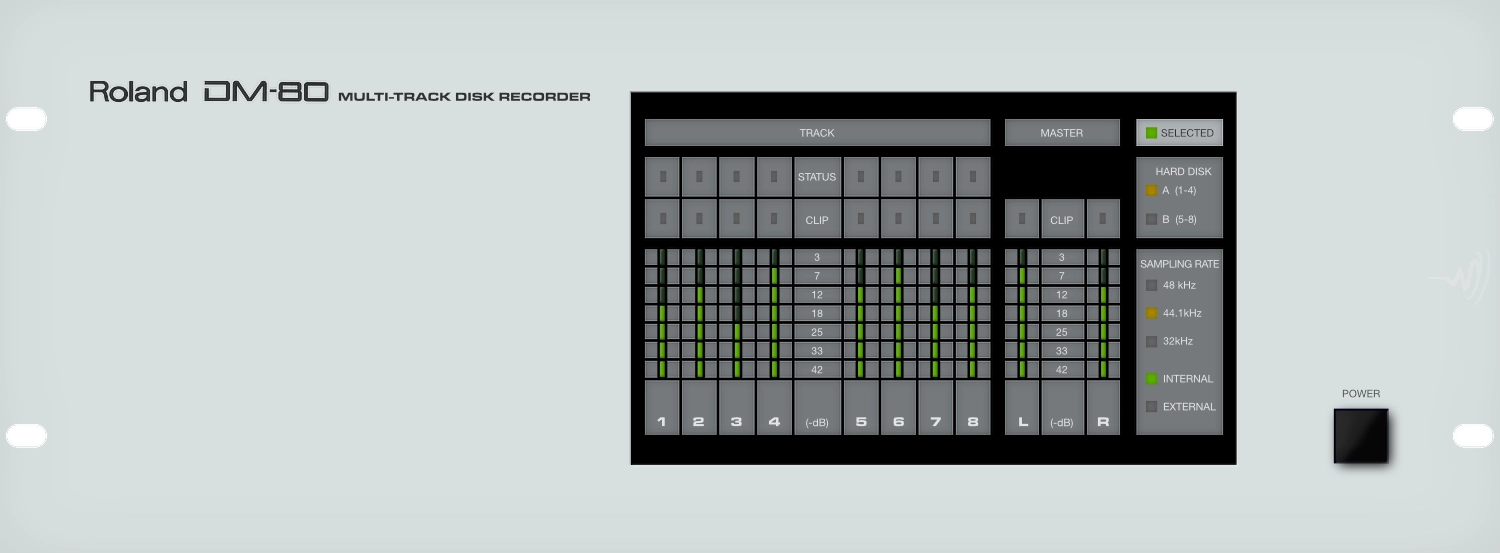
The Roland DM-80 is an affordable mufti track recorder system for tapeless recording. It is a complete music production system that provides comprehensive control over recording, playback and editing operations.
Made In Japan
Released in 1991 /
The Roland RSP-550 is a true stereo multi-effects processor offering 39 high-quality algorithms, including lush reverbs, multi-tap delays, pitch shifting, modulation effects, rotary speaker simulation, and an eight-band vocoder. With 48kHz sampling, 21kHz bandwidth, 160 user memories, and deep MIDI control, it delivered professional-grade sound and versatility at a mid-range price, making it a standout choice for studios and live use in the early 1990s.
Made In Japan
Released in 1993 /
Taking what they had learned with the R-880, Roland developed a new SRV reverb, the Roland SRV-330 and it is one of Roland’s finest digital reverbs. The Roland SRV-330 is a fantastic reverb that offers a broad range of reverbs, from real space emulations to retro gear emulations, and they all sound fantastic with smooth tails and low noise.
Explore the full Series

Classic Tracks Using Roland Gear

Click for deep dives into iconic songs, the gear, engineers, and studios behind the recordings